Question
Explain ac voltage applied on a series LCR circuit and give its analytical solution.

Answer

SELF

Need a full question paper?

Generate a complete, print-ready paper with questions like this in minutes — across 16+ boards, with answer keys.
Start Generating Free

Similar questions

  1. Compare the individual dipole moment and the specimen dipole moment for H2O molecule and O2 molecule when placed in:
  1. Absence of external electric field.
  2. Presence of external eclectic field. Justify your answer.
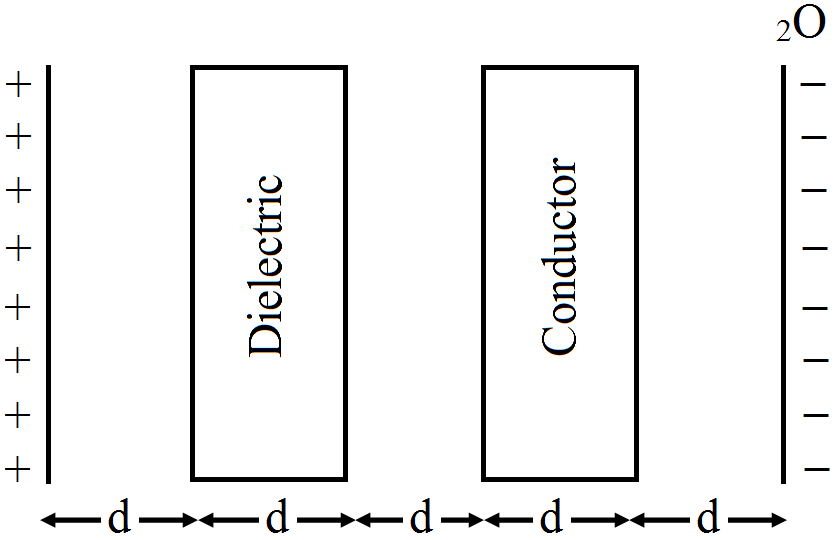
  1. Given two parallel conducting plates of area A and charge densities $+\sigma$ and $-\sigma.$ A dielectric slab of constant K and a conducting slab of thickness d each are inserted in between them as shown.

  1. Find the potential difference between the plates.
  2. Plot E versus x graph, taking x = 0 at positive plate and x = 5d at negative plate.
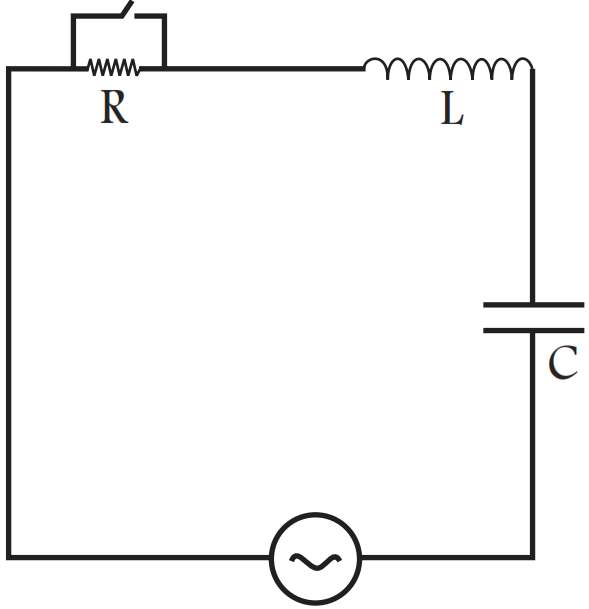
In the LCR circuit shown in Fig, the ac driving voltage is $\text{v}=\text{v}_\text{m}\sin\omega\text{t}$.

  1. Write down the equation of motion for q(t).
  2. At t = t0, the voltage source stops and R is short circuited. Now write down how much energy is stored in each of L and C.
  3. Describe subsequent motion of charges

What are X-rays? If a X-ray tube is operated at V volt then prove that the minimum wavelength of X-rays emitted from the tube is given by: $\lambda_{min}=(12375/V)Å$
A thin prism of angle $6.0^\circ,\omega=0.07$ and $\mu_\text{y}=1.50$ is combined with another thin prism having $\omega=0.08$ and $\mu_\text{y}=1.60.$ The combination produces no deviation in the mean ray.
  1. Find the angle of the second prism.
  2. Find the net angular dispersion produced by the combination when a beam of white light passes through it.
  3. If the prisms are similarly directed, what will be the deviation in the mean ray
  4. Find the angular dispersion in the situation described in (c).
Find the diameter of the image of the moon formed by a spherical concave mirror of focal length 7.6m. The diameter of the moon is 3450km and the distance between the earth and the moon is 3.8 × 10⁵km.
An ideal gas is trapped between a mercury column and the closed-end of a narrow vertical tube of uniform base containing the column. The upper end of the tube is open to the atmosphere. The atmospheric pressure equals 76cm of mercury. The lengths of the mercury column and the trapped air column are 20cm and 43cm respectively. What will be the length of the air column when the tube is tilted slowly in a vertical plane through an angle of 60°? Assume the temperature to remain constant.
Discuss the diffraction of monochromatic light at single thin slit. Establish the formula for angular width of central maxima and secondary maxima.
What is meant by rectification? Draw a diagram of a half wave rectifier electric circuit. Write a brief description of its working. Draw the waveforms of input voltage and output voltage for this rectifier circuit.
A converging lens of focal length 15cm and a converging mirror of focal length 10cm are placed 50cm apart with common principal axis. A point source is placed in between the lens and the mirror at a distance of 40cm from the lens. Find the locations of the two images formed.
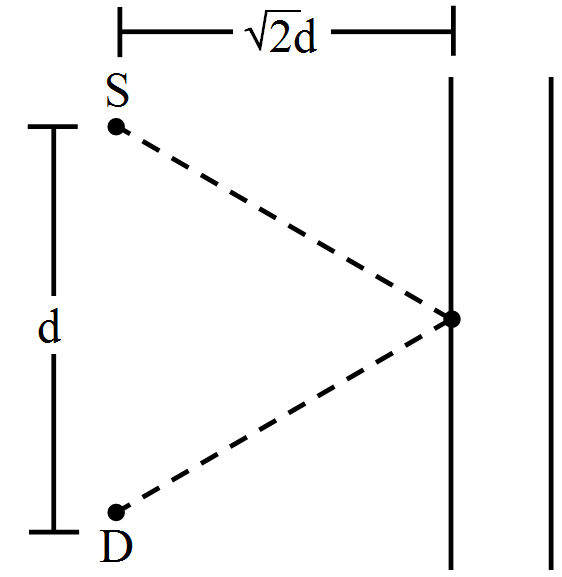
A source S and a detector D are placed at a distance d apart. A big cardboard is placed at a distance $\sqrt{2}\text{d}$ from the source and the detector as shown in figure, The source emits a wave of wavelength $=\frac{\text{d}}{2}$ which is received by the detector after reflection from the cardboard. It is found to be in phase with the direct wave received from the source. By what minimum distance should the cardboard be shifted away so that the reflected wave becomes out of phase with the direct wave?