Question
Explain aldol condensation reaction in detail.

Answer

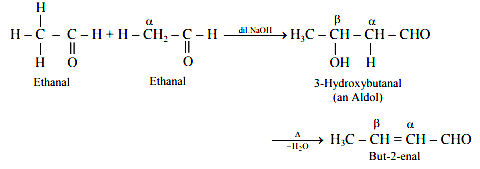
  1. Aldehydes containing at least one α–hydrogen atom undergo a reaction in presence of dilute alkali (dilute $NaOH, KOH$, or $Na_2CO_3$) as the catalyst to form $\beta$-hydroxy aldehydes (aldol). This reaction is known as the aldol reaction.
  2. Formation of aldol is an addition reaction.
  3. Aldol formed from aldehyde having $\alpha $-hydrogens undergoes subsequent elimination of water molecule on warming. This gives rise to α,β-unsaturated aldehyde.
  4. The overall reaction is called aldol condensation. It is a nucleophilic addition-elimination reaction.
  5. The reaction can be given as,
    $\begin{array}{cc}
    \ce{\underset{\text{Aldehyde}}{2R - CH2 - CHO} ->[aq.NaOH] R - CH2 - CH - CHR - CHO}\\
    \phantom{......................}|\\
    \phantom{........................}\ce{\underset{\text{Aldol}}{OH}}
    \end{array}$
    $\begin{array}{cc}
    \ce{R - CH2 - CH - CHR - CHO ->[-H2O][warm] \underset{\text{α,β-Unsaturated aldehyde}}{R - CH = CR - CHO}}\\
    |\phantom{...................................}\\
    \ce{OH}\phantom{...................................}
    \end{array}$
    e.g.
  6. Ketones containing at least two α-hydrogen also undergo aldol condensation reaction and give an $\alpha ,\beta$-unsaturated ketone.
    e.g.

Need a full question paper?

Generate a complete, print-ready paper with questions like this in minutes — across 16+ boards, with answer keys.

Start Generating Free

Similar questions

Define the following terms :
(1) Standard electrode potential
(2) Standard oxidation potential
(3) Standard reduction potential.
For each of the following reactions, identify the Lowry-Bronsted conjugate acid-base pairs:
(1) $CH _3 COOH _{( aq )}+ NH _3 \rightleftharpoons N H _{4( aq )}^{+}+$
$CH _3 COO _{( aq )}^{-}$
(2) $CN _{(\text {aq) }}^{-}+ H _2 O _{(i) } \rightleftharpoons OH _{( aq )}^{-}+ H C N _{( aq )}$ 
(3) $HPO _{4( aq )}^{2-}+ H _2 O _{( i )} \rightleftharpoons OH _{( aq )}^{-}+ H _2 PO _{4( aq )}^{-}$
An organic compound A with molecular formula $C_4H_{10}O$ on treatment with phosphorus pentachloride gives alkyl chloride. Alkyl chloride on treatment with Mg in presence of dry ether gives a highly reactive compound B.
Compound B reacts with water to give hydrocarbon C. Alkyl chloride on treatment with Na in dry ether as a solvent gives alkane, $2,2,3,3$-tetramethylbutane. Identify ‘A’, ‘B’, ‘C’
Complete the missing entries.

Image

Write Clemmenson's reduction reaction of propanone. Write Fehling solution test for ethanal.
The bond enthalpies of $H _{2( g )}, Br _{2( g )}$ and $HBr _{( g )}$ are $436 kJ mol ^{-1}, 193 kJ mol ^{-1}$ and $366 kJ mol ^{-1}$ respectively. Calculate the enthalpy change for the following reaction,
$H _{2(g)}+ Br _{2(g)} \rightarrow 2 HBr _{( g )} \text {. }$
Write the structural formula and IUPAC names of all possible isomers of the compound with molecular formula $C _3 H _8 O$.
Write a short note on Hoffmann elimination.
Ammonia serves as a Lewis base whereas $AlCl _3$ is Lewis acid. Explain.
Boiling point of a solvent is $80.2^{\circ} C$. When $0.419 g$ of the solute of molar mass $252.4 g mol ^{-1}$ is dissolved in $75 g$ of the above solvent, the boiling point of the solution is found to be $80.256^{\circ} C$. Find the molal elevation constant.