Question
Explain aldol condensation with suitable example. ### Write a short note: Aldol condensation.

Answer

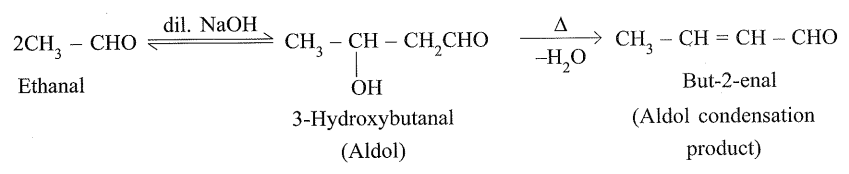
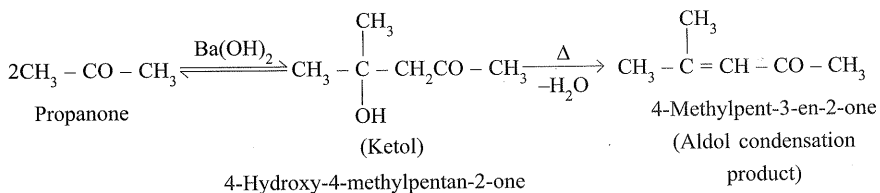
→ Aldol condensation: "Aldehydes and ketones having at least one a-hydrogen undergo a reaction in the presence of dilute alkali as catalyst to form ẞ-hydroxy aldehydes (aldol) or ẞ-hydroxy ketones (ketol), respectively. This is known as Aldol reaction."
Image
Image
→ The name aldol is derived from the names of the two functional groups, aldehyde and alcohol, present in the products. The aldol and ketol readily lose water to give $\alpha$, ẞ-unsaturated carbonyl compounds which are aldol condensation products and the reaction is called Aldol condensation. Though ketones give ketols (compounds containing a keto and alcohol groups), the general name aldol condensation still applies to the reactions of ketones due to their similarity with aldehydes.

Need a full question paper?

Generate a complete, print-ready paper with questions like this in minutes — across 16+ boards, with answer keys.
Start Generating Free

Similar questions

Calculate the amount of $KCl$ which must be added to $1\ kg$ of water so that the freezing point is depressed by $2K.\ (K_f$ for water $= 1.86\ K\ kg\ mol^{–1}).$
An element crystallizes in a f.c.c. lattice with cell edge of $250$ pm. Calculate the density if 300 g of this element contain $2\times 10^{24}$ atoms.
Examine the given defective crystal:
Answer the following questions:
  1. Is the above defect stoichiometric or non-stoichiometric?
  2. write the term used for the electron occupied site.
  3. Give an example of the compound which shows this type of defect.
Write the Nernst equation and calculate emf of the following cell at $298 K:$
$ Cr \left| Cr ^{3+}(0 \cdot 1 M ) \| Fe ^{2+}(0 \cdot 01 M )\right| Fe$
$\text { Given : } E _{ Cr ^{3+} / Cr }^{\ominus}=-0 \cdot 75 V$
$E _{ Fe ^{2+} / Fe }^{\ominus}=-0 \cdot 45 V (\log 10=1)$
  1.  
  1.  
  1. $\text{CH}_{3}-\text{CH}_{2}-\text{ Br}\xrightarrow{\text{AgCN } } ?$
Explain kohlrausch Law with example.
Rate constant k for first order reaction has been found to be $2.54 \times 10^{-3} s^{-1}$. Calculate its three-fourth life.
How would you differentiate between $S_N1$ and $S_N2$ mechanisms of substitution reactions? Give one example of each.
Give reasons :
(i) Carbon-oxygen bond length in phenol is slightly less than that of methanol.
(ii) The $C - O - C$ bond angle present in ether is greater than the tetrahedral angle.
(iii) The boiling point of isomeric alcohols decreases with increase in branching.
Outline the principles of refining of metals by the following methods:
Vapour phase refining