Question
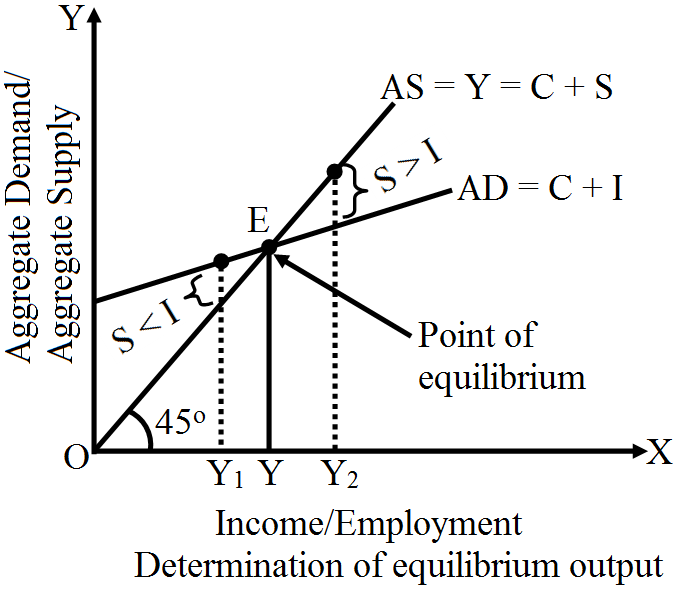
Explain all the changes that will take place in an economy when Aggregate Demand is not equal to Aggregate Supply.
AD > AS: When AD is greater than AS, flow of goods and services in the economy tends to be less than their demand. The existing stocks of the producers will be sold out. To rebuild the desired stocks, the producers will plan greater production. AS will increase to become equal to AD.
AD < AS: When AD is less than AS, flow of goods and services in the economy tends to exceed their demand. As a result, some of the goods will remain unsold. To clear unwanted stocks, the producers would plan a cut in production. Consequently, AS will reduce to become equal to AD. This is how AS adapts itself to AD.
Generate a complete, print-ready paper with questions like this in minutes — across 16+ boards, with answer keys.
| (Rs. in crores) | ||
| 1 | Interest. | 150 |
| 2 | Rent. | 250 |
| 3 | Government final consumption expenditure. | 600 |
| 4 | Private final consumption expenditure. | 1200 |
| 5 | Profits. | 640 |
| 6 | Compensation of employees. | 1000 |
| 7 | Net factor income to abroad. | 30 |
| 8 | Net indirect taxes. | 60 |
| 9 | Net exports. | (-)40 |
| 10 | Consumption of fixed capital. | 50 |
| 11 | Net domestic capital formation. | 340 |
| Output units | Total cost Rs. | Average variable cost Rs. | Marginal cost Rs. | Average fixed cost Rs. |
| 0 | 30 | | | |
| 1 | --- | --- | 20 | --- |
| 2 | 68 | --- | --- | --- |
| 3 | 84 | 18 | --- | --- |
| 4 | --- | --- | 18 | --- |
| 5 | 125 | 19 | --- | 6 |