Question
Explain ambidentate ligand with example.
Answer

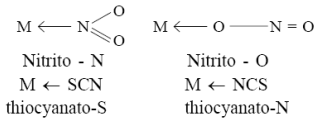
⇒ Ligands that can attach themselves to the central metal atom through two different atoms are called ambidentate ligands.
⇒ Examples of such ligands are the NO-2 and SCN- ions. NO-2 ion can coordinate either through nitrogen or through oxygen to a central metal atom/ion.
⇒ Similarly, SCN- ion can coordinate through the sulphur or nitrogen atom.

Image

Need a full question paper?

Generate a complete, print-ready paper with questions like this in minutes — across 16+ boards, with answer keys.

Start Generating Free

Similar questions

On what factors do the products obtained from electrolysis a solution of an electrolyte depend?
Write the following conversions:
nitrobenzene → acetanilide
A graph between ln k and $\frac{1}{\text{t}}$ for a reaction is given. Here k is rate constant and T is temperature in Kelvin.

If OA = a and OB = b, answer the following:
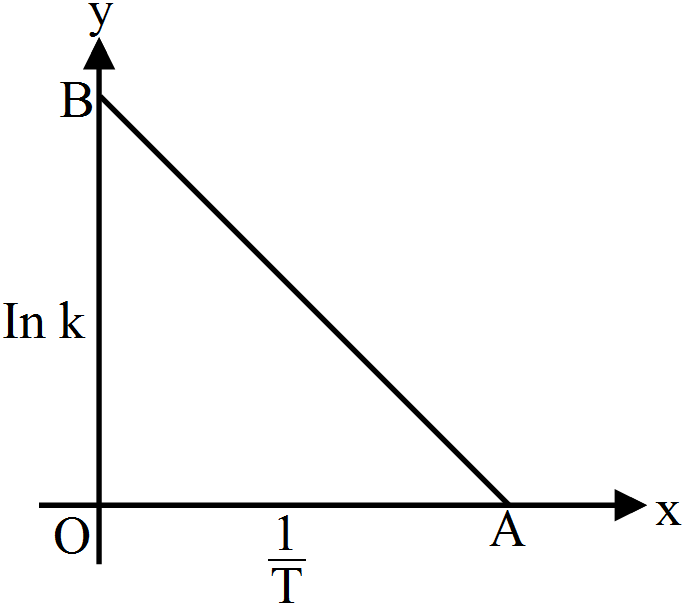
  1. What is the activation energy (Ea) of the reaction?
  2. What is the frequency factor (A) for the reaction?

What are essential and non - essential amino acids? Give two examples of each type.
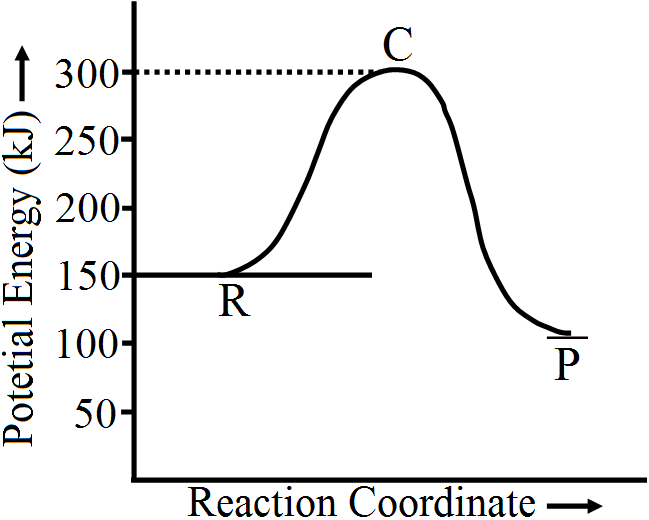
Answer the following questions on the basis of the given plot of potential energy vs reaction coordinate:

  1. What is the threshold energy for the reaction?
  2. What is the activation energy for forward reaction?
  3. What is the activation energy for backward reaction?
  4. What is enthalpy change for the forward reaction?

For the first order thermal decomposition reaction, the following data were obtained:
$\text{C}_{2}\text{H}_{5}\text{Cl}\text{(g)}\rightarrow \text{C}_{2}\text{H}_{4}\text{(g)} + \text{HCl}\text{(g)} $
Time/sec Total pressure/atm
0 0.30
300 0.50
Calculate the rate constant
(Given: log 2 = 0.301, log 3=0.4771, log 4 =0.6021)
Give the structures of A, B and C in the following reaction:

$\text{C}_6\text{H}_5\text{NO}_2\xrightarrow[]{\text{Fe}/\text{HCl}}\text{A}\xrightarrow[273\text{K}]{\text{NaNO}_2+\text{HCl}}\text{B}\xrightarrow[\Delta]{\text{H}_2\text{O}/\text{H}^+}\text{C}$

Explain the rate expression for a reaction in which stoichiometric coefficients of reactants and produch are not same or unit.
Compare the chemistry of actinoids with that of the lanthanoids with special reference to:
Oxidation state