Maharashtra BoardEnglish MediumSTD 11 ScienceChemistryHydrocarbons3 Marks
Question
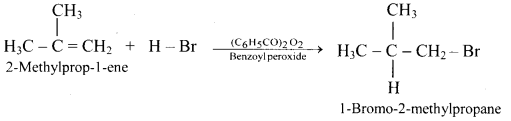
Explain Anti-Markovnikov’s addition or peroxide effect or Kharasch-Mayo effect.
✓
Answer
In 1933, M. S. Kharasch and F. R. Mayo discovered that the addition of HBr to unsymmetrical alkene in the presence of organic peroxide (R-O-O-R) takes place in the opposite orientation to that suggested by Markovnikov’s rule. e.g. $H _3 C -\underset{\text { Propene }}{ CH }= CH _2+ H - Br \underset{\text { Benzoylperoxide }}{\left( C _6 H _5 CO _2 O _2\right.} \underset{\text { 1-Bromopropane }}{ H _3 C - CH _2- CH _2- Br }$
Need a full question paper?
Generate a complete, print-ready paper with questions like this in minutes — across 16+ boards, with answer keys.