Question
Explain aqueous alkaline hydrolysis of tert. butyl bromide.
Answer

i. Aqueous alkaline hydrolysis of tert. butyl bromide forms tert-butyl alcohol. The reaction can be given as,
$\begin{array}{cc}
\ce{\phantom{....}CH3\phantom{.........................}}\ce{CH3\phantom{............}}\\
|\phantom{.............................}|\phantom{...........}\\
\ce{CH3 - C - Br +\underset{\text{Nucleophile}}{OH-} ->CH3 - C - OH +\underset{\text{Bromide ion}}{Br-}}\\
|\phantom{.............................}|\phantom{...........}\\
\ce{\underset{\text{Tert-Butyl bromide}}{CH3}\phantom{.................}}
\ce{\underset{\text{tert−Butyl alcohol}}{CH3}}\phantom{.........}\\
\end{array}$
Rate = $k [(CH_3)_3C − Br]$
ii. The reaction follows the first-order kinetics. That is, the rate of this reaction depends on the concentration of only one species, which is the substrate molecule, tert-butyl bromide. Hence, it is called substitution nucleophilic unimolecular, $S_N1$ mechanism.
iii. It can be seen in the reaction that the concentration of the only substrate appears in the rate equation that is, the concentration of the nucleophile does not influence the reaction rate.
iv. In other words, tert-butyl bromide reacts with hydroxide by a two steps mechanism.
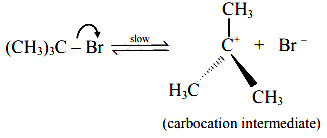
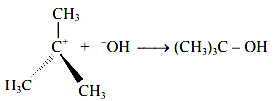
In the slow step C–X bond in the substrate undergoes heterolysis and in the subsequent fast step, the nucleophile uses its electron pair to form a new bond with the carbon undergoing change.
v. The $S_N1$ mechanism is represented as,
  • Step I:
  • Step II:

Need a full question paper?

Generate a complete, print-ready paper with questions like this in minutes — across 16+ boards, with answer keys.

Start Generating Free