Question
Explain barrier potential of $p-n$ junction.

Answer


Image
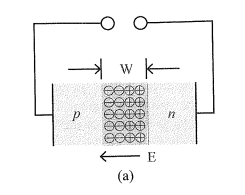
The loss of electrons from the $n$-region and the gain of electron by the $p$-region causes a difference of potential across the junction of the two regions.
Image
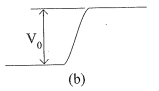
The polarity of this potential is such as to oppose further flow of carriers so that a condition of equilibrium exists.
Fig. shows $p-n$ junction at equilibrium and the potential across the junction.
Since the potential tends to prevent the movement of electron from the $n$-region into the $p$-region, it is often called a barrier potential.

Need a full question paper?

Generate a complete, print-ready paper with questions like this in minutes — across 16+ boards, with answer keys.
Start Generating Free

Similar questions

A charge of $3.14 \times 10^{-6}C$ is distributed uniformly over a circular ring of radius 20.0cm. The ring rotates about its axis with an angular velocity of 60.0 rad/s. Find the ratio of the electric field to the magnetic field at a point on the axis at a distance of 5.00cm from the centre.
Three identical metal plates with large surface areas are kept parallel to each other as shown in figure. The leftmost plate is given a charge Q, the rightmost a charge -2Q and the middle one remains neutral. Find the charge appearing on the outer surface of the rightmost plate.
The temperature and relative humidity in a room are 300K and 20% respectively. The volume of the room is $50m^3.$ The saturation vapour pressure at 300K is 3.3kPa. Calculate the mass of the water vapour present in the room.
As the earth rotates about its axis, a person living in his house at the equator goes in a circular orbit of radius equal to the radius of the earth. Why does he/ she not feel weightless as a satellite passenger does?
The number of electrons in an insulator is of the same order as the number of electrons in a conductor. What is then the basic difference between a conductor and an insulator?
A person riding a car moving at 72km/h sounds a whistle emitting a wave of frequency 1250Hz. What frequency will be heard by another person standing on the road.
  1. In front of the car.
  2. Behind the car? Speed of sound in air = 340m/s.
Find the,
  1. maximum frequency, and
  2. minimum wavelength of X-rays produced by 30 kV electrons.
Calculate the amount of energy released during the $\alpha - $ decay of $^{238}_{92}\text{U}\to ^{234}_{92}\text{Th} + ^{4} _{2}\text{He}$Given:
  1. Atomic mass of $^{238}_{92}\text{U}= 238.05079u$
  2. Atomic mass of $^{234}_{90}\text{Th}= 234.04363u$
  3. Atomic mass of $^{4}_{2}\text{He}= 4.00260\text{ u}$
$\text{1u} = 931.5 \text{MeV/c}^{2}$
Is this decay spontaneous? Give reason.
What are eddy currents? How are these produced? In what sense are eddy currents considered undesirable in a transformer and how are these reduced in such a device?
A rod of length L is placed along the X-axis between x = 0 and x = L. The linear density (mass/ length) $\rho$ of the rod varies with the distance x from the origin as $\rho=\text{a + bx.}$
  1. Find the SI units of a and b.
  2. Find the mass of the rod in terms of a, b and L.