Question
Explain barrier potential of $p-n$ junction.

Answer


Image
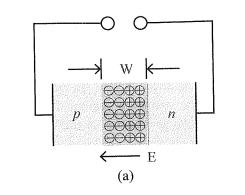
The loss of electrons from the $n$-region and the gain of electron by the $p$-region causes a difference of potential across the junction of the two regions.
Image
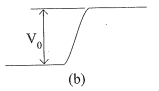
The polarity of this potential is such as to oppose further flow of carriers so that a condition of equilibrium exists.
Fig. shows $p-n$ junction at equilibrium and the potential across the junction.
Since the potential tends to prevent the movement of electron from the $n$-region into the $p$-region, it is often called a barrier potential.

Need a full question paper?

Generate a complete, print-ready paper with questions like this in minutes — across 16+ boards, with answer keys.
Start Generating Free

Similar questions

How many time constants will elapse before the power delivered by a battery drops to half of its maximum value in an RC circuit?
You are given a low resistance R1 a high resistance R2 and a moving coil galvanometer. Suggest how would you use these to have an instrument that will be able to measure?
  1. Current.
  2. Potential difference.
A beam of monochromatic radiation is incident on a photosensitive surface. Answer the following questions giving reasons.
i. Do the emitted photoelectrons have the same kinetic energy?
ii. Does the kinetic energy of the emitted electrons depend on the intensity of incident radiation?
iii. On what factors does the number of emitted photoelectrons depend?
What is amplitude modulation ? Draw the simple block diagram of a modulator to get amplitude modulated wave.
A small telescope has an objective lens of focal length 144 cm and an eyepiece of focal length 6.0 cm. What is the magnifying power of the telescope? What is the separation between the objective and the eyepiece?
A particle is projected with a speed u at an angle $\theta$ with the horizontal. Consider a small part of its path near the highest position and take it approximately to be a circular arc. What is the radius of this circle? This radius is called the radius of curvature of the curve at the point.
The electric field in a region is given by $\overrightarrow{\text{E}}=\frac{3}{5}\text{E}_0\overrightarrow{\text{i}}+\frac{4}{5}\text{E}_0\overrightarrow{\text{j}}$ with $\text{E}_0=2.0\times10^3\text{NC}^{-1}.$ Find the flux of this field through a rectangular surface of area 0.2m2 parallel to the y-z plane.
Half life of $^{238}\text{U}_{92}$against$\alpha$ decay is $4.5 \times 10^{9}$years. Calculate the activity of Ig sample of$^{238}\text{U}_{92}$? Given Avogadro's number $= 6 \times 10^{26}$atoms/kmol.
An electromagnetic wave of wavelength λ is incident on a photosensitive surface of negligible work function. If the photo-electrons emitted from this surface have the de-Broglie wavelength $\lambda_{1}$, prove that $\lambda = \begin{pmatrix} 2 \text{mc} \\ h \end{pmatrix}\lambda^{2}_{1}$.
What is the effect on the interference fringes in Young’s double slit experiment due to each of the following operations? Justify your answers.
  1. The screen is moved away from the plane of the slits.
  2. The separation between slits is increased.
  3. The source slit is moved closer to the plane of double slit.