Question
Explain Bayer’s process.

Answer

1. In Bayer's process, the bauxite ore is first crushed and then it is leached by heating with hot concentrated caustic soda $( NaOH )$ solution under high pressure for 2 to $8 hrs$ at 140 to $150^{\circ} C$ in a tank called a digester.
2. Aluminium oxide, being amphoteric in nature, dissolves in an aqueous $NaOH$ solution, forming water-soluble sodium aluminate.
$
\underset{\substack{\text { Aluminium } \\ \text { oxide }}}{ Al _2 O _3 \cdot 2 H _2 O _{( s )}}+\underset{\substack{\text { Sodium } \\ \text { hydroxide }}}{2 NaOH _{( aq )}} \longrightarrow \underset{\substack{\text { Sodium } \\ \text { aluminate }}}{2 NaAlO _{2( aq )}}+\underset{\text { Water }}{3 H _2 O _{( l )}}
$
3. The iron oxide present in the gangue does not dissolve in aqueous $NaOH$ solution and is separated by filtration.
4. However, silica from the gangue dissolves in aqueous $NaOH$ solution forming water-soluble sodium silicate.
5. The solution of sodium aluminate is diluted with water and then cooled to $50^{\circ} C$. This gives aluminium hydroxide as a precipitate.
$
\underset{\substack{\text { Sodium } \\ \text { aluminate }}}{ NaAlO _{2( aq )}}+\underset{\text { Water }}{2 H _2 O _{( l )}} \longrightarrow \underset{\substack{\text { Sodium } \\ \text { hydroxide }}}{ NaOH _{( aq )}}+\underset{\text { hydroxide }}{ Al ( OH )_3 \downarrow}
$
6. The aluminium hydroxide is then filtered, washed, dried and calcined by heating at $1000^{\circ} C$ to get pure aluminium oxide, called alumina.
$
\underset{\substack{\text { Aluminium } \\ \text { hydroxide }}}{2 Al ( OH )_{3( s )}} \stackrel{\text { heat }}{1000^{\circ} C } \underset{\substack{\text { Aluminium } \\ \text { oxide }}}{ Al _2 O _{3( s )}}+\underset{\substack{\text { Water } \\ \text { vapour }}}{3 H _2 O _{( g )}}
$

Need a full question paper?

Generate a complete, print-ready paper with questions like this in minutes — across 16+ boards, with answer keys.
Start Generating Free

Similar questions

Draw a neat labelled diagram: Hydraulic separation method.
The germ cell A produced by a person X is round in shape and it fuses with another germ cell B having a long tail and produced by a person Y. The fusion of A and B produces a new cell C. The cell C divides repeatedly and grows inside the organ D of person X to form E in which the body features of the unborn baby are not much developed. E grows further to form F in which the various body features of the unborn baby (like hands, legs, head, eyes, and ears, etc.) can be identified. F grows further and ultimately forms a baby. What are A, B, C, D, E and F? Out of the two persons X and Y, which one is male and which one female?
When water is added gradually to a white solid $X, $ a hissing sound is heard and a lot of heat is produced forming a product $Y.$ A suspension of $Y$ in water is applied to the walls of a house during white washing. A clear solution of $Y$ is also used for testing carbon dioxide gas in the laboratory.
  1. What could be solid $X?$ Write its chemical formula.
  2. What could be product $Y?$ Write its chemical formula.
  3. What is the common name of the solution of $Y$ which is used for testing carbon dioxide gas$?$
  4. Write chemical equation of the reaction which takes place on adding water to slid $X.$
  5. Which characteristic of chemical reactions is illustrated by this example$?$
Explain with diagram step-by-step energy conversion in Solar thermal power plant.
Identify the class of given animals and write one characteristic of each animal:
i. Kangaroo
ii. Penguin
iii. Crocodile
iv. Frog
v. Sea-horse
Construction of a compound microscope:
(1) A compound microscope consists of a metal tube fitted with two convex lenses at the two ends. These lenses are called the objective lens (the lens directed towards the object) and the eyepiece (the lens directed towards the eye). Both the lenses are small in size, but the cross section of the objective lens is less than that of the eyepiece. The objective lens has a short focal length. The focal length of the eyepiece is more than that of the objective lens.(2) The metal tube is mounted on a stand. The principal axes of the objective lens and the eyepiece are along the same line. The distance between the object and the objective lens can be changed with a screw. It is possible to change the distance between the objective lens and the eyepiece.
Working:
(1) The object to be observed is illuminated and placed in front of the objective lens, slightly beyond the focal length of the objective lens. Its real, inverted and enlarged image is formed by the, objective lens on the other side.
(2) This intermediate image lies within the focal length of the eyepiece. It serves as an object for the eyepiece. The eyepiece works as a simple microscope. The final image is virtual, highly enlarged and inverted with respect to the original object. It can be formed at the minimum distance of distinct vision from the eyepiece. The final image is observed by keeping the eye close to the eyepiece.
Use: This microscope is used to observe blood cells, microorganisms, etc.
1.In a compound microscope, which lens has greater focal length?
2.Where do you place the object to be observed with a compound microscope?
3.State which distance is adjusted to observe the object with a compound microscope.
4.State the nature of the final image in compound microscope relative to the object.
5.State the use of a compound microscope.
Write the names of biodiversity hot spots?
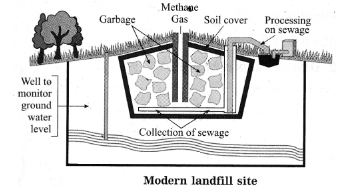
Observe the diagram and answer the following questions:
Image

(a) Name the following method of solid waste management.
(b) What type of waste is used in this method?
(c) What kind of useful substances can be obtained from such methods?

Every household produces a lot of material A daily. In one of the methods of disposal B, material A is burned at a very high temperature of about 1000°C in a structure called C. During this process, the organic matter present is removed as D and E whereas F is left behind (which can be dumped in a landfill site).
  1. What is material A?
  2. Name the method of disposal B.
  3. What is structure C known as?
  4. What are (i) D (ii) E, and (iii) F?
  5. This method is especially suitable for the disposal of materials produced by certain institutions. Name such institutions.
The organs P and Q of two animals have different structures but similar functions. On the other hand, the two organs R and S of two other animals have the same basic structure but different functions.
  1. What are the organs like P and Q known as?
  2. Name the organs like P and Q. Also name the animals which have such organs.
  3. What are the organs like R and S called?
  4. Name the organs like R and S. Also name the animals which have such organs.