Question
Explain bimolecular nucleophilic substitutio $(SN^2)$ reaction with example.

Answer

$\rightarrow$ In the year $1937$, Edward Davies Hughes at Sir Christopher Ingold proposed a mechanis for an $SN^2$ reaction.
$\rightarrow$ The reaction between $CHCl_3$ and hydroxide in to yield methanol and chloride ion follows second order kinetics.
$\rightarrow$ The rate depends upon the concentration of both the reactants.
$\rightarrow$ Rate $= \ce{K [CH_3CI]^1 [OH]^1}$
Image
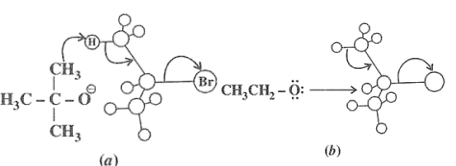
$\rightarrow$ The incoming nucleophile interacts with alkyl halide causing the carbon$-$halide bond to break and a new bond is formed between carbon and attacking nucleophile.
$\rightarrow$ Here it is $C-O$ bond formed between $C$ and $-OH.$ These two processes take place simultaneously in a single step and no intermediate is formed.
$\rightarrow$ As the reaction progresses and the bond between the incoming nucleophile and the carbon atom starts forming, the bond between carbon atom and leaving group weakens.
$\rightarrow$ As this happens, the three carbon$-$hydrogen bonds of the substrate start moving away from the attacking nucleophile.
$\rightarrow$ In transition state all the three $C-H$ bonds are in the same plane and the attacking and leaving nucleophiles are partially attached to the carbon.
$\rightarrow$ As the attacking nucleophile approaches closer to the carbon, $C-H$ bonds still keep on moving in the same direction till the attacking nucleophile attaches to carbon and leaving group leaves the carbon.
$\rightarrow$ As a result configuration is inverted, this process is called inversion of configuration.
$\rightarrow$ In the transition state, the carbon atom is simultaneously bonded to incoming nucleophile and the outgoing leaving group.
$\rightarrow$ Such structures are unstable and cannot be isolated. Thus, in the transition state, carbon is simultaneously bonded to five atoms.

Need a full question paper?

Generate a complete, print-ready paper with questions like this in minutes — across 16+ boards, with answer keys.
Start Generating Free

Similar questions

Explain with examples the terms weak and strong electrolytes.
How would you account for the following:
There is a gradual decrease in the atomic sizes of transition elements in a series with increasing atomic numbers.
Oxidation of ketones involves carboncarbon bond cleavage. Name the products formed on oxidation of 2, 5-dimethylhexan-3-one.
The conductivity of $2.5 \times 10^{-4} M$ methanoic acid is $5.25 \times 10^{-5} S cm ^{-1}$ and its $\wedge_{ m }^0$ has a value $400 S cm ^2 mol^{-}$ 1. Calculate its molar conductivity and degree of dissociation.
What is Electrolytic cell? Explain simplest electrolytic cell in details?
One of the two figures given below represents substitution and the other represents elimination. Indicate which is substitution and which is elimination.
Image
Explain the products obtained from electrolysis of aqueous solution of sodium chloride on the basis of electrode potential values.
Match the items of column $I$ with items of column $II$.
 
Column $I$
 
Column $II$
$(i)$
Antifreeze used in car engine
$(a)$
Neutral ferric chloride
$(ii)$
Solvent used in perfumes
$(b)$
Glycerol
$(iii)$
Starting material for picric acid
$(c)$
Methanol
$(iv)$
Wood spirit
$(d)$
Phenol
$(v)$
Reagent used for detection of phenolic group
$(e)$
Ethleneglycol
$(vi)$
By product of soap industry used in cosmetics
$(f)$
Ethanol.
Explain Crystal field splitting in tetrahedral complax.
  1. The cell in which the following reaction occurs:
$2 Fe^{3+} (aq) + 2 I^- (aq) \longrightarrow 2 Fe^{2+}(aq) + I_2 (s)$
has $\text{E}^0_{\text{cell}} = 0·236 V$ at $298 K.$ Calculate the standard Gibbs energy of the cell reaction. $($Given : $1 F = 96,500\ C\ mol^{-1})$
  1. How many electrons flow through a metallic wire if a current of $0·5\ A$ is passed for $2$ hours? $($Given : $1 F = 96,500\ C\ mol^{-1})$