Maharashtra BoardEnglish MediumSTD 12 SciencePhysicsQuestion Bank [ 2022 ]3 Marks
Question
Explain Biot Savart's Law.
✓
Answer
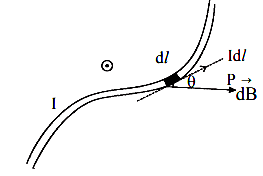
i. Consider an arbitrarily shaped wire carrying a current I. ii. Let $dl$ be a length element along the wire. The current in this element is in the direction of the length vector $\overrightarrow{ dl }$ which produces differential magnetic field $\overrightarrow{ dB }$ directed into the plane of the paper as shown in the figure below: Current carrying wire of arbitrary shape iii. Consider point $P$ at distance $r$ from element $dl$. The net magnetic field at point $P$ can be obtained by integrating i.e., summing up of magnetic fields $\overrightarrow{ dB }$ from these length elements. iv. Experimentally, the magnetic fields $\overrightarrow{ dB }$ produced by current $I$ in the length element $\overrightarrow{ dl }$ is $dB =\frac{\mu_0}{4 \pi} \frac{\text { Idlsin } \theta}{ r ^2}$ ....(1) where $\theta$ is the angle between the directions of $\overrightarrow{ dl }$ and $\overrightarrow{ r }, \mu_0$ (permeability of free space) $=$ $ 4 \pi \times 10^{-7} T m / A \approx 1.26 \times 10^{-6} T m / A $ v. The direction of $\overrightarrow{ dB }$ is dictated by the cross product $\overrightarrow{ dl } \times \overrightarrow{ r \text {. }}$ Vectorially, $\overrightarrow{ dB }=\frac{\mu_0}{4 \pi} \frac{\overrightarrow{ Idl } \times \overrightarrow{ r }}{ r ^3}$ Equations (1) and (2) are known as the Biot-Savart law.
Need a full question paper?
Generate a complete, print-ready paper with questions like this in minutes — across 16+ boards, with answer keys.