Question
Explain boiling point of alkyl halides.

Answer

→ Molecules of organic halogen compounds are generally polar.
→ Due to greater polarity as well as higher molecular mass as compared to the parent hydrocarbon, the intermolecular forces ofattraction (dipole-dipole and van der Waals) are
stronger in the halogen derivatives.
→ That is why the boiling points of chlorides, bromides and iodides are considerably higher than those of the hydrocarbons of comparable molecular mass.
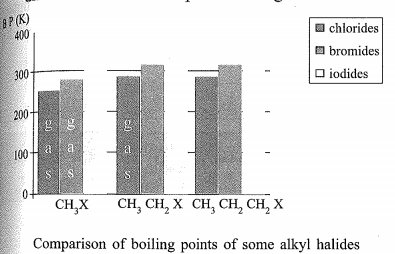
→ The pattern of variation of boiling points of different halides is depicted in Fig.
Image
→ For the same alkyl group, the boiling points of alkyl halides decrease in the order: RI> RBr> RCI> RF.
→ This is because with the increase in size and mass of halogen atom, the magnitude of van der Waal forces increases.
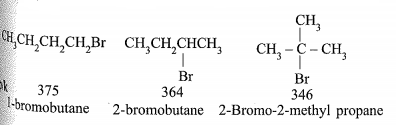
→ The boiling points of isomeric haloalkanes decrease with increase in branching (1°>2°>3°).
→ For example, 2-bromo-2- methylpropane has the lowest boiling point among the three isomers.
Image

Need a full question paper?

Generate a complete, print-ready paper with questions like this in minutes — across 16+ boards, with answer keys.

Start Generating Free

Similar questions

Give reasons:
  1. n-Butyl bromide has higher boiling point than t-butyl bromide.
  2. Racemic mixture is optically inactive.
  3. The presence of nitro group $(–NO_2)$ at o/p positions increases the reactivity of haloarenes towards nucleophilic substitution reactions.
Determine the formula for the half life of a first order reaction and prove that the half life of a first order reaction does not depends on the initial concentration of the reactant.
What is a semiconductor? Describe the two main types of semiconductors and explain mechanisms for their conduction.
What happens when
i. n-butyl chloride is treated with alcoholic KОН.
ii. bromobenzene is treated with Mg in the presence of dry ether.
iii. chlorobenzene is subjected to hydrolysis.
The following data were obtained during the first order thermal decomposition of $SO_2Cl_2$ at a constant volume:
$SO_2Cl_2(g) \rightarrow SO_2(g) + Cl_2(g)$
Experiment
Time/s$^{-1}$
Total pressure/atm
$1$
$2$
$0$
$100$
$0.4$
$0.7$
Calculate the rate constant.
$($Given$: \log 4 = 0.6021, \log  2 = 0.3010)$
Explain the following terms with one example in each case:
  1. Food preservatives.
  2. Enzymes.
  3. Detergents.
The conductivity of $0.001028 \mathrm{~mol} \mathrm{~L}^{-1}$ acetic acid is $4.95 \times 10^{-5} \mathrm{~S} \mathrm{~cm}^{-1}$. Calculate its dissociation constant $\Lambda_{\mathrm{m}}^{\circ}$ if for acetic acid is $390.5 \mathrm{~S} \mathrm{~cm}^2 \mathrm{~mol}^{-1}$.
Define the following with an example of each:
  1. Write the product when D-glucose reacts with conc. $HNO_3$.
  2. Amino acids show amphoteric behaviour. Why?
  3. Write one difference between $\alpha$-helix and $\beta$-pleated structures of proteins.
What is the secondary structure of proteins?
i. Write the mechanism of the following SN1 reaction:
$\left(\mathrm{CH}_3\right)_3 \mathrm{C}-\mathrm{Br} \xrightarrow{A q . \mathrm{NaOH}}\left(\mathrm{CH}_3\right)_3 \mathrm{C}-\mathrm{OH}+\mathrm{NaBr}$
ii. Write the equation for the preparation of 2-methyl-2-methoxypropane by Williamson synthesis.