Question
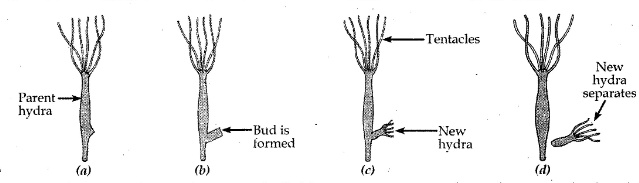
Explain budding in Hydra with the help of diagrams only.

Answer


Budding in Hydra. Hydra reproduces by budding which is an asexual type of reproduction.

During this type of reproduction, a bulb-like projection arises from the parent body which is known as bud. The bud may be unicellular or multicellular formed by mitotic division of its cells. This bud then grows gradually to from a small hydra. And finally, the tiny new hydra detaches itself from the body of the body of the parent hydra and lives as a separate organism. Thus, the parent hydra produce a new hydra.

Need a full question paper?

Generate a complete, print-ready paper with questions like this in minutes — across 16+ boards, with answer keys.
Start Generating Free

Similar questions

A convex lens of focal length 0.10m is used to form a magnified image of an object of height 5mm placed at a distance of 0.08m from the lens. Calculate the position, nature and size of the image.
Why is atomic number considered to be a more appropriate parameter than atomic mass for the classification of elements in a periodic table? How does the metallic character of elements vary as we move (i) from left to right in a period, and (ii) top to bottom in a group in the modern periodic table? Give reasons to justify your answers.
The farmers have been cultivating a food plant X for over two thousand years and have produced as many as five entirely different looking vegetables A, B, C, D and E from it.
  1. What could the plant X be?
  2. What are A, B, C, D and E?
  3. What is the process of evolution involved in this example known as?
Describe the working of a hydrogen bomb.
“It is a matter of chance whether a couple will have a male or a female child." Justify this statement by drawing a flow chart.
What makes the candle flame yellow and luminous?
What is voluntary nervous system? Explain the working of voluntary nervous system with an example.
Zn is more electropositive than Fe. Therefore, it should get corroded faster than Fe. But it does not happen. Instead, it is used to galvanize iron. Explain why does it happen so?
In a monohybrid cross between tall pea plants (TT) and short pea plants ( tt ) a scientist obtained only tall pea plants ( Tt ) in the $F _1$ generation. However, on selfing the $F_1$ generation pea plants, he obtained both tall and short plants in $F_2$ generation. On the basis of above observations with other angiosperms also, can the scientist arrive at a law? If yes, explain the law. If not, give justification for your answer.
Find the position and nature of the image of an object 5cm high and 10cm in front of a convex lens of focal length 6cm.