Question
Explain Cannizzaro reaction.###Write a note on Cannizzaro reaction###
✓
Answer
- Aldehydes which do not have a-hydrogen atom, on heating with concentrated alkali ($50 \%$ aqueous or ethanolic solution of NaOH or KOH) undergo self oxidation and reduction reaction or redox reaction.
- This self redox reaction or disproportionation reaction is called Cannizzaro reaction.
- In this reaction one molecule of the aldehyde is oxidised to carboxylic acid while the second molecule of the aldehyde is reduced to alcohol (carboxylic acid formed, reacts with alkali, NaOH and forms a salt R – COONa).
- When formaldehyde (methanal) is heated with 50% NaOH solution, methanol (reduction product) and sodium formate (oxidation product) are formed.
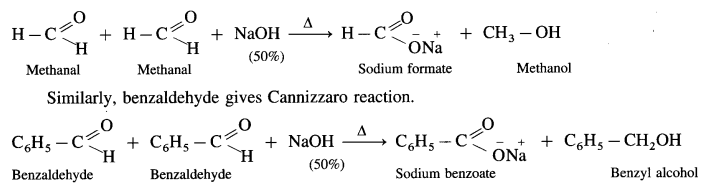
- Ketones and aldehydes like acetaldehyde, propionaldehyde, etc. having a – H atom do not give Cannizzaro reaction.
Need a full question paper?
Generate a complete, print-ready paper with questions like this in minutes — across 16+ boards, with answer keys.
Explore more
Similar questions
Write the factors influencing the basicity of amines.
The vapour pressure of water at 20 °C is 17 mm Hg. What is the vapour pressure of solution containing 2.8 g urea in 50 g of water? (16.17 mm Hg)
Define:
(a) Standard enthalpy of combustion.
(b) Enthalpy of atomization.
Draw the structure of D-ribose sugar.
Write the uses of bronze alloy.
(a) Standard enthalpy of combustion.
(b) Enthalpy of atomization.
Draw the structure of D-ribose sugar.
Write the uses of bronze alloy.
Predict the sign of $\Delta S$ in the following processes. Give reasons for your answer: ### Explain with reason sign conventions of $\Delta S$ in the following reactions.
(a) $N _2 O _{4( g )} \longrightarrow 2 NO _{2( g )}$
(b) $Fe _2 O _{3( s )}+3 H _{2( g )} \longrightarrow 2 Fe _{( s )}+3 H _2 O _{( g )}$
(c) $N _{2( g )}+3 H _{2( g )} \longrightarrow 2 NH _{3( g )}$
(d) $MgCO _{3( s )} \longrightarrow MgO _{( s )}+ CO _{2( g )}$
(e) $CO _{2( g )} \longrightarrow CO _{2( s )}$
(f) $C l _{2( g )} \longrightarrow 2 Cl _{( g )} \quad$
→(a) $N _2 O _{4( g )} \longrightarrow 2 NO _{2( g )}$
(b) $Fe _2 O _{3( s )}+3 H _{2( g )} \longrightarrow 2 Fe _{( s )}+3 H _2 O _{( g )}$
(c) $N _{2( g )}+3 H _{2( g )} \longrightarrow 2 NH _{3( g )}$
(d) $MgCO _{3( s )} \longrightarrow MgO _{( s )}+ CO _{2( g )}$
(e) $CO _{2( g )} \longrightarrow CO _{2( s )}$
(f) $C l _{2( g )} \longrightarrow 2 Cl _{( g )} \quad$
Define state function and write two examples of it.
Calculate the enthalpy of the reaction,
$CH _3 COOH _{( g )}+ CH _3 CH _2 OH _{( g )} \rightarrow CH _3 COOCH _2 CH _{3( g )}+ H _2 O _{( g )}$
Bond enthalpies of $O - H , C - O$, in $kJmol ^{-1}$ are 464,351 respectively.
→$CH _3 COOH _{( g )}+ CH _3 CH _2 OH _{( g )} \rightarrow CH _3 COOCH _2 CH _{3( g )}+ H _2 O _{( g )}$
Bond enthalpies of $O - H , C - O$, in $kJmol ^{-1}$ are 464,351 respectively.
Explain Hofmann’s exhaustive alkylation.###Explain Hofmann’s exhaustive methylation of amines.
Mention the number of unpaired electrons and geometry of following complexes:
(i) $\left[ Ni ( Cl )_4\right]^{2-}$
(ii) $\left[ Ni ( CN )_4\right]^{2-}$
Convert the following:
(a) Ethanenitrile into ethanal.
(b) Cyclohexane into adipic acid.
→(i) $\left[ Ni ( Cl )_4\right]^{2-}$
(ii) $\left[ Ni ( CN )_4\right]^{2-}$
Convert the following:
(a) Ethanenitrile into ethanal.
(b) Cyclohexane into adipic acid.
What are the types of the salts? Give examples.
(a) $Sn _{( aq )}^{2+}+2 AgCl _{( s )} \rightarrow Sn _{( aq )}^{4+}+2 Ag ( s )+2 Cl _{( aq )}^{-}$
The overall reaction takes place into two steps:
(i) $Sn _{( aq )}^{2+} \rightarrow Sn ^{4+}+2 e ^{-}$(Oxidation half reaction)
(ii) $2 AgCl _{( s )}+2 e ^{-} \rightarrow 2 Ag _{( s )}+2 Cl _{\text {(aq) }}^{-}$(Reduction half reaction)
Hence the cell is,
$Pt \left| Sn _{\text {(aq }}^{2+}, Sn _{\text {(aq) }}^{4+} \| Cl _{\text {(aq) }}^{-}(1 M )\right| AgCl _{( s )} \mid Ag _{( s )}$
(b) $Mg _{( s )}+ Br _{2(l)} \rightarrow Mg _{( aq )}^{2+}+2 Br _{( aq )}^{-}$
The overall reaction takes place into two steps:
(i) $Mg _{( s )} \longrightarrow Mg _{\text {(aq) }}^{2+}+2 e ^{-}$
(Oxidation half reaction)
(ii) $Br _{2()}+2 e ^{-} \longrightarrow 2 Br _{\text {(aq) }}^{-}$
(Reduction half reaction)
Hence the cell is,
$Mg _{( s )}\left| Mg _{( aq )}^{2+}(1 M ) \| Br _{( aq )}^{-}(1 M )\right| Br _{2( l )} \mid Pt$
→The overall reaction takes place into two steps:
(i) $Sn _{( aq )}^{2+} \rightarrow Sn ^{4+}+2 e ^{-}$(Oxidation half reaction)
(ii) $2 AgCl _{( s )}+2 e ^{-} \rightarrow 2 Ag _{( s )}+2 Cl _{\text {(aq) }}^{-}$(Reduction half reaction)
Hence the cell is,
$Pt \left| Sn _{\text {(aq }}^{2+}, Sn _{\text {(aq) }}^{4+} \| Cl _{\text {(aq) }}^{-}(1 M )\right| AgCl _{( s )} \mid Ag _{( s )}$
(b) $Mg _{( s )}+ Br _{2(l)} \rightarrow Mg _{( aq )}^{2+}+2 Br _{( aq )}^{-}$
The overall reaction takes place into two steps:
(i) $Mg _{( s )} \longrightarrow Mg _{\text {(aq) }}^{2+}+2 e ^{-}$
(Oxidation half reaction)
(ii) $Br _{2()}+2 e ^{-} \longrightarrow 2 Br _{\text {(aq) }}^{-}$
(Reduction half reaction)
Hence the cell is,
$Mg _{( s )}\left| Mg _{( aq )}^{2+}(1 M ) \| Br _{( aq )}^{-}(1 M )\right| Br _{2( l )} \mid Pt$