Question
Explain Capital Reserve and give its any two examples.

Answer

Capital Reserves are set aside out of capital profits and are normally not available for distribution as dividend. In other words, reserve created out of capital profits and which is not readily available for distribution as dividend among the shareholders is called Capital Reserve.
Examples of capital reserves are:
  1. Profit prior to incorporation.
  2. Premium on issue of shares or debentures.

Need a full question paper?

Generate a complete, print-ready paper with questions like this in minutes — across 16+ boards, with answer keys.

Start Generating Free

Similar questions

Enter the following transactions in the Double Column Cash Book of M/s. Gupta Store:
2019
 
June 1
Cash in Hand ₹ 800, Bank overdraft ₹ 5,700
 
June 7
Received a cheque from Bharati, discount allowed ₹ 150
3,250
June 9
Deposited the above cheque into Bank
 
June 15
Cheque received from Panna Lal
1,200
June 20
Bharati's cheque returned dishonoured
 
June 28
Panna Lal's cheque was endorsed to Kamal
 
June 30
Income tax paid by cheque
150
Journalise the following trasactions:
2019
 
March 1
Started business with cash
50,000
March 2
Purchased Machinery for cash
20,000
Paid installation charges on machinery
2,000
March 5
Purchased goods from X of the list price of ₹ 25,000, Trade Discount 20% and cash discount 5%. Payment was made in cash immediately
 
March 10
Sold goods to Y costing ₹ 10,000 at 30% profit on cost less 10% trade discount
 
March 15
Paid Rent
1,000
March 20
Goods stolen from business
2,000
March 22
Gave as charity: Cash
100
Goods
200
March 31
Purchased Post Cards and Envelopes
50
March 31
Purchased a Computer for business
25,000
From the following items prepare a Bank Reconciliation Statement on 31st May 2015:
  1. Bank balance as per Cash Book on 31st May 2015 ₹ 17,600.
  2. Cash and cheques totalling ₹ 36,000 were sent to bank during May but one cheque of ₹ 11,800 was shown in the Pass Book on 2nd June.
  3. As per instructions bankers have directly collected ₹ 4,100 from a customer but there is no mention of it in the Cash Book.
  4. Three cheques for ₹ 10,000, ₹ 12,000 and ₹ 4,800 respectively were drawn on 27th May but the cheque for ₹ 4,800 was encashed on 1st June.
  5. On 31st May bankers had debited ₹ 45 as bank charges but had intimated it on 3rd June.
  6. ₹ 16,200 were withdrawn from bank on 25th May but there is no entry for it in the Cash Book.
Rectify the following errors:
  1. Credit sales to Mridula ₹ 5,000 were not recorded.
  2. Credit purchases from Nayna ₹ 8,000 were not recorded.
  3. Goods returned to Priya ₹ 12,000 were not recorded.
  4. Goods returned from Rashi ₹ 10,000 were not recorded.
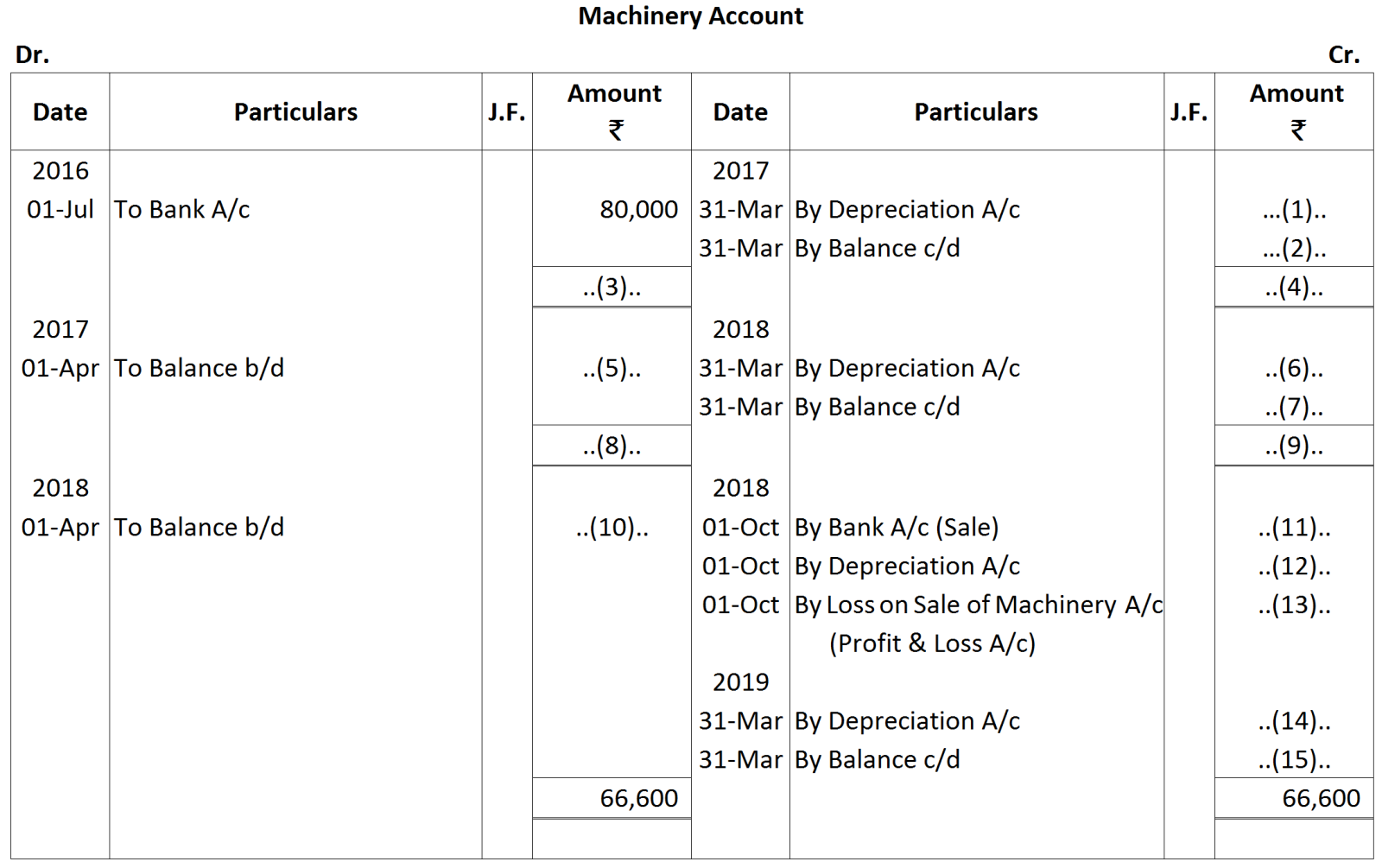
In the following Machinery Account, determine the missing values, if depreciation is to be charged @ 10% p.a. per Diminishing Balance Method. On 1st October, 2018, a part of the machinery valued in the books of the firm at ₹ 16,000 on 1st July, 2016 was sold for ₹ 10,000.
Journalise the following transactions in the books of Dixit & Sons.:
2018
 
March 2
Sold goods to Dilip of the list price of ₹ 62,000 for ₹ 60,000.
March 16
Purchased goods costing ₹ 2,00,000 from Hari & Co. Paid 75% immediately by cheque to avail 4% discount.
March 20 Sold goods to Vishal Traders costing ₹ 40,000 at 25% profit, allowing 10% trade discount and 10% cash discount. Received 80% payment immediately by cheque.
March 26 Sold goods to Brij & Co. costing ₹ 50,000 at 40% profit, allowing 10% trade discount and 5% cash discount. Brij & Co. paid the full amount by cheque and availed cash discount.
Rectify the following errors:
  1. The Sales Book has been totalled ₹ 1,000 short.
  2. Goods worth ₹ 1,500 returned by Green and Co. have not been recorded anywhere.
  3. Goods purchased worth ₹ 2,500 have been posted to the debit of the supplier, Gupta and Co.
  4. Furniture purchased from Gulab and Co. worth ₹ 10,000 has been entered in Purchases Day Book.
  5. Cash received from A ₹ 2,500 has not been posted in his account.
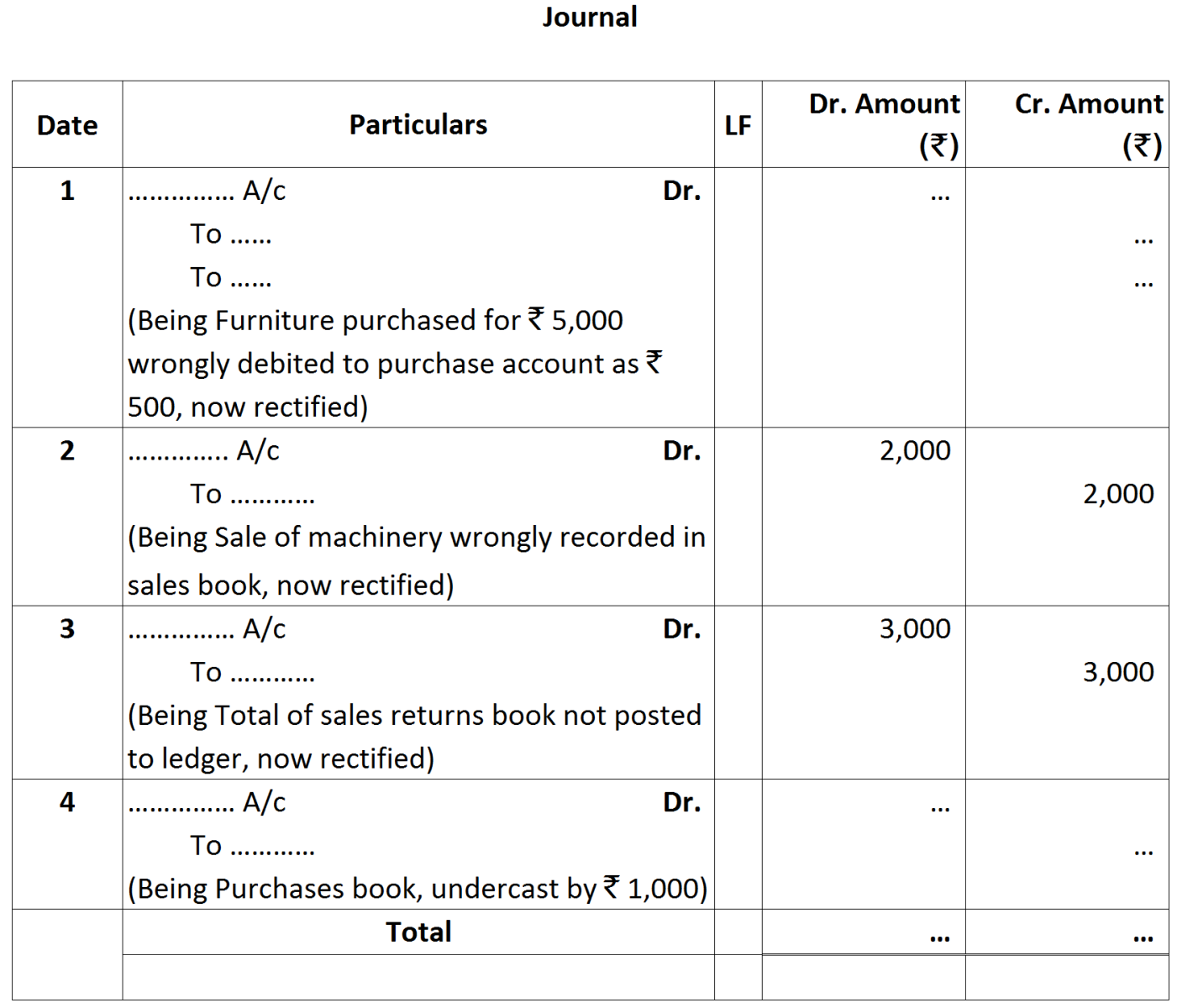
Complete the following Rectification Entries:
“Only financial transactions are recorded in Accountancy.” Explain the statement.
Why is it important to adopt a consistent basis for the preparation of financial statements? Explain.