Question
Explain chlor-alkali process and write balanced chemical equations for the reactions that occur. Name the gases obtained at the anode and cathode respectively. Mention two uses each of the two gases obtained in the above process.

Answer

• Chlor-akali process - When electricity is passed through aqueous solution of sodium chloride (brine), it decomposes toform sodium hydroxide, chlorine and hydrogen.
• $2 NaCl(aq)-2 H_2 O(l) \rightarrow 2 NaOH+Cl_2+H_2$
• Anode - Chlorine gas $/ Cl _2$
• Cathode - Hydrogen gas: $H _2$
• $Cl_2$
1. Used in the preparation of bleaching powder.
2. To make drinking water free from germs or any other.
• $H_{2}$
1. Used in the manufacture of ammonia fertilisers.
2. Used in fuels and margarine.

Need a full question paper?

Generate a complete, print-ready paper with questions like this in minutes — across 16+ boards, with answer keys.
Start Generating Free

Similar questions

A metal X forms a water soluble salt XNO3. When an aqueous solution of XNO3 is added to common salt solution, then a white precipitate of compound Y is formed alongwith sodium nitrate solution. Metal X is said to be the best conductor of electricity and it does not evolve hydrogen when put in dilute hydrohloric acid.
  1. What is metal X?
  2. What is salt XNO3?
  3. Name the compound Y.
  4. Write the chemical equation of the reaction which takes place on reacting XNO3solution and common salt solution giving the physical states of all the reactants and products.
  5. What type of chemical reaction is illustrated by the above equation?
A non - metal X which is the largest constituent of air combines with hydrogen when heated in the presence of iron as catalyst to form a gas Y. When gas Y is treated with sulphuric acid, it forms a compound Z which is used as a chemical fertiliser.
  1. What are X, Y and Z?
  2. To which group of periodic table does X belong?
  3. Name the period of periodic table in which X is placed.
  4. Which element is placed just before X in the period?
  5. Which element is placed just after X in the period?
State and explain the reaction, if any, of the following metals with a solution of copper sulphate:
  1. Gold.
  2. Copper.
  3. Zinc.
  4. Mercury.
State one use each of the following metals:
Copper, Aluminium, Iron, Silver, Gold, Mercury
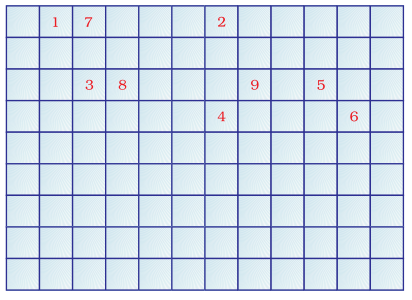
Complete the following cross word puzzle (Figure).

Across:

  1. An element with atomic number 12.

  1. Metal used in making cans and member of Group 14.

  2. A lustrous non-metal which has 7 electrons in its outermost shell.

​​​​​​​Down:

  1. Highly reactive and soft metal which imparts yellow colour when subjected to flame and is kept in kerosene.

  1. The first element of second Period.

  2. An element which is used in making fluorescent bulbs and is second member of Group 18 in the Modern Periodic Table.

  3. A radioactive element which is the last member of halogen family.

  4. Metal which is an important constituent of steel and forms rust when exposed to moist air.

  5. The first metalloid in Modern Periodic Table whose fibres are used in making bullet-proof vests.

What is meant by ‘rusting of iron’? With the help of labelled diagrams, describe an activity to find out the conditions under which iron rusts.
Sampleof five metals ‘A’, ‘B’, ‘C’, ‘D’ and ‘E’ was taken and added to the following solution one by one. The results obtained have been tabulated as follows.
MetalFeSO4CuSO4ZnSO4AgNO3Al2(SO4)3MgSO4
ANo reactionDisplacementNo reactionDisplacementNo reactionNo reaction
BDisplacementDisplacementNo reactionDisplacementNo reactionNo reaction
CNo reactionNo reactionNo reactionDisplacementNo reactionNo reaction
DNo reactionNo reactionNo reactionNo reactionNo reactionNo reaction
EDisplacementDisplacementDisplacementDisplacementNo reactionNo reaction
Use the above table to answer the following questions about the given metals.
  1. Which of them is most reactive and why?
  2. What would you observe if ‘B’ is added to CuSO4?
  3. Arrange ‘A’, ‘B’, ‘C’, ‘D’ and ‘E’ in the increasing order of reactivity.
  4. Container of which metal can store zinc sulphate and silver nitrate solution?
  5. Which of the above solution(s) can be stored in a container made of any of these metals and why?
An organic compound A on heating with concentrated H2SO4 forms a compound B which on addition of one mole of hydrogen in presence of Ni forms a compound C. One mole of compound C on combustion forms two moles of CO2 and 3 moles of H2O. Identify the compounds A, B and C and write the chemical equations of the reactions involved.
Both soap and detergent are some type of salts. What is the difference between them? Describe in brief the cleansing action of soap. Why do soaps not form lather in hard water? List two problems that arise due to the use of detergents instead of soaps.
A non-metal A which is the largest constituent of air, when heated with H2 in 1 : 3 ratio in the presence of catalyst (Fe) gives a gas B. On heating with O2 it gives an oxide C. If this oxide is passed into water in the presence of air it gives an acid D which acts as a strong oxidising agent.
  1. Identify A, B, C and D.
  2. To which group of periodic table does this non-metal belong?