Question
Explain Competition as a population Interaction with suitable examples.

Answer

→ It is a process in which fitness of one species ('r'value) is significantly lower in presence of another species.
→ Interspecific competition is a potent force in organic evolution.
→ Competition occurs when closely related species compete for the same limited resources.
→ Unrelated species can also compete for the resource. E.g. Flamingoes & fishes in some shallow South American lakes compete for zooplankton.
→ Competition occurs in abundant resources also. E.g. In interference competition, the feeding efficiency of one species is reduced due to the interfering and inhibitory presence of other species, even if resources are abundant.
Evidences for competition :
→ The Abingdon tortoise in Galapagos Islands became extinct within a decade after goats were introduced on the island, due to greater browsing efficiency of the goats.
→ Competitive release : It is the expansion of distributional range of a species when the competing species is removed.
→ Connell's field experiments : On the rocky sea coasts of Scotland, there are 2 barnacle species: Balanus (lager & competitively superior) & Chthamalus (smaller). Balanus dominates intertidal area and excludes Chthamalus. When Connell experimentally removed Balanus, Chthamalus colonized the intertidal zone.
→ Gause's 'Competitive Exclusion Principle' :
→ It states that two closely related species competing for the same resources cannot co- exist indefinitely and the competitively inferior one will be eliminated eventually. This may be true in limited resources, but not otherwise.
→ Species facing competition may evolve mechanisms for co-existence rather than exclusion. E.g. resource partitioning.
→ Resource partitioning : It is the division of limited resources by species to avoid competition. For this, they choose different feeding times or different foraging patterns. E.g. MacArthur showed that five closely related species of warblers living on a tree could avoid competition and co-exist due to behavioural differences in their foraging activities.
Need a full question paper?

Generate a complete, print-ready paper with questions like this in minutes — across 16+ boards, with answer keys.

Start Generating Free

Similar questions

A patient is suffering from ADA deficiency. Can he be cured? How?
Describe different outbreeding devices in detail.###Describe different devices to discourage self pollination.###Describe different devices to encourage cross pollination.
Explain in situ approach for conservation of biodiversity.
Why are vectors needed for replication of DNA during rDNA technology?
Write a short note on endosperm development.
What is chromosomal disorder? Explain any two aneuploidy with characters in humans.###Mention any two autosomal genetic disorders with their symptoms.
With labeled diagrams describe the mechanism of Pollen-pistil Interaction.
Read the following and answer any four questions front (i) to (v) given below:
Gene regulation is the mechanism of switching off and switching on of the genes depending upon the requirement of cells and the state of development. Gene regulation is of two types : negative and positive. In negative generegulation the genes continue expressing their effect till their activity is suppressed. Positive gene regulation is the one in which the genes remain non-expressed unless and until they are induced to do it. Operon model is a co-ordinated group of genes such as structural gene, operator gene, promoter gene, regulator gene which function together and regulate a metabolic pathway as a unit, e.g., lac operon, trp operon, ara operon, etc.
  1. Regulation of gene expression occurs at the level of.
  1. Transcription
  2. Processing/splicing
  3. Translation
  4. All of these.
  1. Inducible operon system usually occurs in A pathways. Nutrient molecules serve as B to stimulate production of the enzymes necessary for their breakdown. Genes for inducible operon are usually switched C and the repressor is synthesised in an D form.
S.no
A
B
C
D
(a)
anabolic
corepressor
on
inactive
(b)
anabolic
inducer
off
active
(c)
catabolic
inducer
off
active
(d)
catabolic
corepressor
on
inactive
  1. An mRNA molecule transcribed from the lac operon contains nucleotide sequences complementary to.
  1. Structural genes coding for the enzymes.
  2. the operator region
  3. the promotor region
  4. the repressor gene.
  1. Which statement correctly describes the control of transcription of the genes involved in the breakdown of lactose in Estherichia coli?
  1. A repressor protein binds to the operator and the genes are switched on.
  2. A repressor protein binds to the operator and the genes are switched off.
  3. A transcription factor binds to the promoter and the genes are switched on.
  4. A transcription factor binds to the promoter and the genes are switched off.
  1. Function of catabolic activator protein in lac operon is.
  1. To form mRNA
  2. Help to bind RNA polymerase
  3. Code for repressor
  4. To activates lac gene when glucose is absent.
Read the following and answer any four questions from (i) to (v) given below:

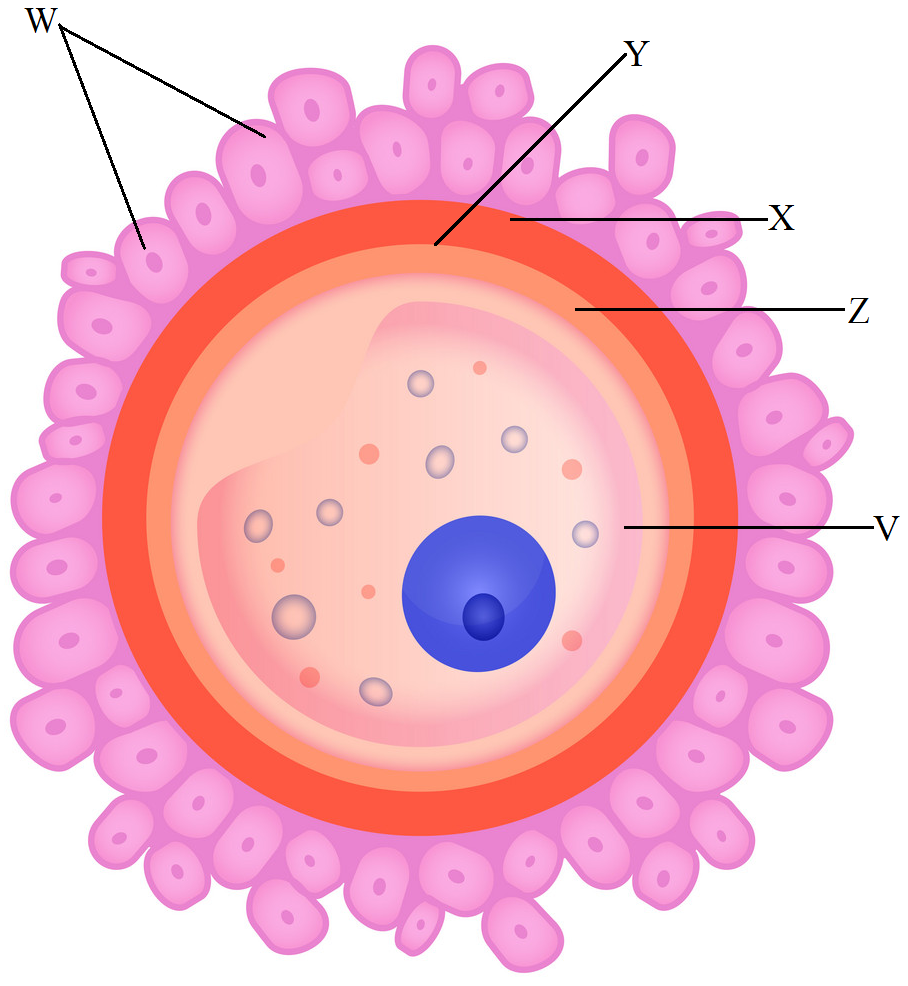
The mature ovum or a female gamete is spherical in shape. The human ovum is almost free of yolk and is said to be alecithal. Human ovum loses its ability to be fertilised about 24 hours after ovulation. Refer to the given structure of ovum and answer the following questions.

  1. Thick cellular layer formed of radially elongated follicular cells is:
  1. Zona pellucida.
  2. Plasma membrane.
  3. Perivitelline membrane.
  4. Corona radiata.
  1. In humans, at which stage does ovum get released from ovary?
  1. Secondary oocyte.
  2. Oogonium.
  3. Primary oocyte.
  4. First polar body.
  1. Cytoplasm of an ovum is enveloped by _____.
  1. Zona pellucida.
  2. Corona radiata.
  3. Cell membrane.
  4. Perivitelline space.
  1. Select the correct option:
S. No
V
W
X
(a)
Cytoplasm
Zona pellucida
Plasma membrane
(b)
Cortical granules
Corona radiata
Zona pellucida
(c)
Cortical granules
Plasma membrane
Corona radiata
(d)
Cytoplasm
Corona radiata
Zona pellucida
  1. Which of the following is not a characteristic of an ovum?
  1. Nucleus of an ovum has prominent nucleolus.
  2. Only one ovum formed from one oogonium.
  3. It lacks centrioles.
  4. It has very small amount of ooplasm.
Describe Sex Determination in honey bee with diagram.