Question
Explain construction of the galvanic cell according to Daniell cell and explain electrode potential.

Answer

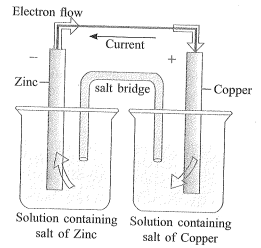
→ We can construct innumerable number of galvanic cells based on the pattern of Daniell cell by taking combination of different half-cells
→ Each half-cell consists of a metallic electrode dipped into an electrolyte. The two half-cells are connected by a mettalic wire through a voltmeter and a switch externally.
→ The electrolytes of the two half-cells are connected internally through a salt bridge as shown in Fig.
Image
→Sometimes, both the electrodes dip in the same elecrtolyte solution and in such cases we don't require a salt bridge.
→At the interface of each electrode and electrolyte, metal ions from the solution tend to deposit on the metal electrode, to make it positively charged.
→ At the same time, metal atoms of the electrode have a tendency to go into the solution as ions leaving behind electrons at the electrode, there by trying to make it negatively charged.
→ At equilibrium, there is a separation of charges occurs, and depending on the tendencies of the two opposing reactions, the electrode may become positively or negatively charged with respect to the solution.
→ A potential difference develops between the electrode and the electrolyte is called as electrode potential.
→ When the concentrations of all the species involved in a half-cell in unity then the electrode potential is known as standard electrode potential.
→ In a galvanic cell, the half-cell in which oxidation takes place is called anode and it hasti a negative potential with respect to the solution.
→ The other half-cell in which reduction takes place is called cathode and it has positive potential with respect to the solution.
→ Thus, there exists a potential difference between the two electrodes and as soon as the switch is in the on position the electrons flow from negative electrode to positive electrode. The direction of current flow is opposite to that of electron flow.

Need a full question paper?

Generate a complete, print-ready paper with questions like this in minutes — across 16+ boards, with answer keys.

Start Generating Free

Similar questions

Explain vapour pressure of solutions of solids in liquids.
Depict the galvanic cell in which the reaction
$Zn ( s )+2 Ag ^{+}( aq ) \rightarrow Zn ^{2+}( aq )+2 Ag ( s )$,
takes place. Further show :
(i) Which of the electrode is negatively charged?
(ii) The carriers of the current in the cell.
(iii) Individual reaction at each electrode.
When fruits and vegetables that have dried are placed in water, they slowly swell and return to the original form. Explain why. Would a temperature increase accelerate the process? Explain.
Heptane and Octane form an ideal solution. At 373 K, the vapour pressures of the two liquid components are 105.2 kPa and 46.8 kPa respectively. What will be the vapour pressure of a mixture of 26.0 g of heptane and 35 g of octane?
An organic compound ‘A’ with molecular formula C8H8O gives positive DNP and iodoform tests. It does not reduce Tollens’ or Fehling’s reagent and does not decolourise bromine water also. On oxidation with chromic acid (H2CrO4), it gives a carboxylic acid (B) with molecular formula C7H6O2. Deduce the structures of A and B.
Write the mechanism of hydration of ethene to yield ethanol.
Account for the following:
  1. CuCl2 is more stable than Cu2Cl2.
  2. Atomic radii of 4d and 5d series elements are nearly same.
  3. Hydrochloric acid is not used in permanganate titrations.
  1. For the complex [Fe(H2O)6]3+, write the hybridization, magnetic character and spin of the complex. (At. number: Fe = 26)
  2. Draw one of the geometrical isomers of the complex [Pt(en)2Cl2]2+ which is optically inactive.
For M2+/M and M3+/M2+ systems the $E ^{\circ}$ values for some metals are as follows : 
$\begin{array}{llll} Cr ^{2+} / Cr & -0.9 V & Cr ^3 / Cr ^{2+} & -0.4 V \\ Mn ^{2+} / Mn & -1.2 V & Mn ^{3+} / Mn ^{2+} & +1.5 V \\ Fe ^{2+} / Fe & -0.4 V & Fe ^{3+} / Fe ^{2+} & +0.8 V\end{array}$
Use this data to comment upon :
(i) the stability of Fe3+ in acid solution are compared to that of Cr3+or Mn3+ and
(ii) the case with which iron can be oxidised as compared to a similar process for either chromium or manganese metal.
State the preparation, properties and uses of methanol.