Question
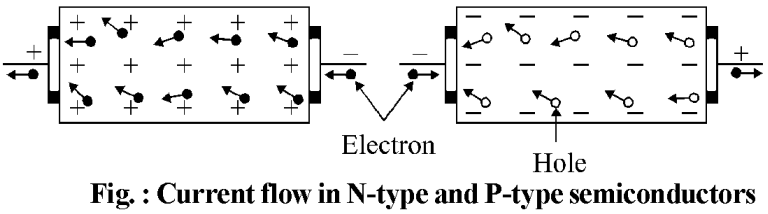
Explain current flow in N- and P-type semiconductors.

Need a full question paper?

Generate a complete, print-ready paper with questions like this in minutes — across 16+ boards, with answer keys.
Start Generating Free

Similar questions

Find the acceleration due to gravity in a mine of depth 640m if the value at the surface is 9.800m/s2. The radius of the earth is 6400km.
An electron beam projected along the positive X-axis deflects along the positive Y-axis. If this deflection is caused by a magnetic field, what is the direction of the field? Can we conclude that the field is parallel to the Z-axis?
Explain destructive interference using proper (appropriate) example.
Draw the graph of variation in potential difference and electric field with distance ' $r$ ' for a point electric charge $Q$.
Write down difference between the Interference pattera and the diffraction pattern.
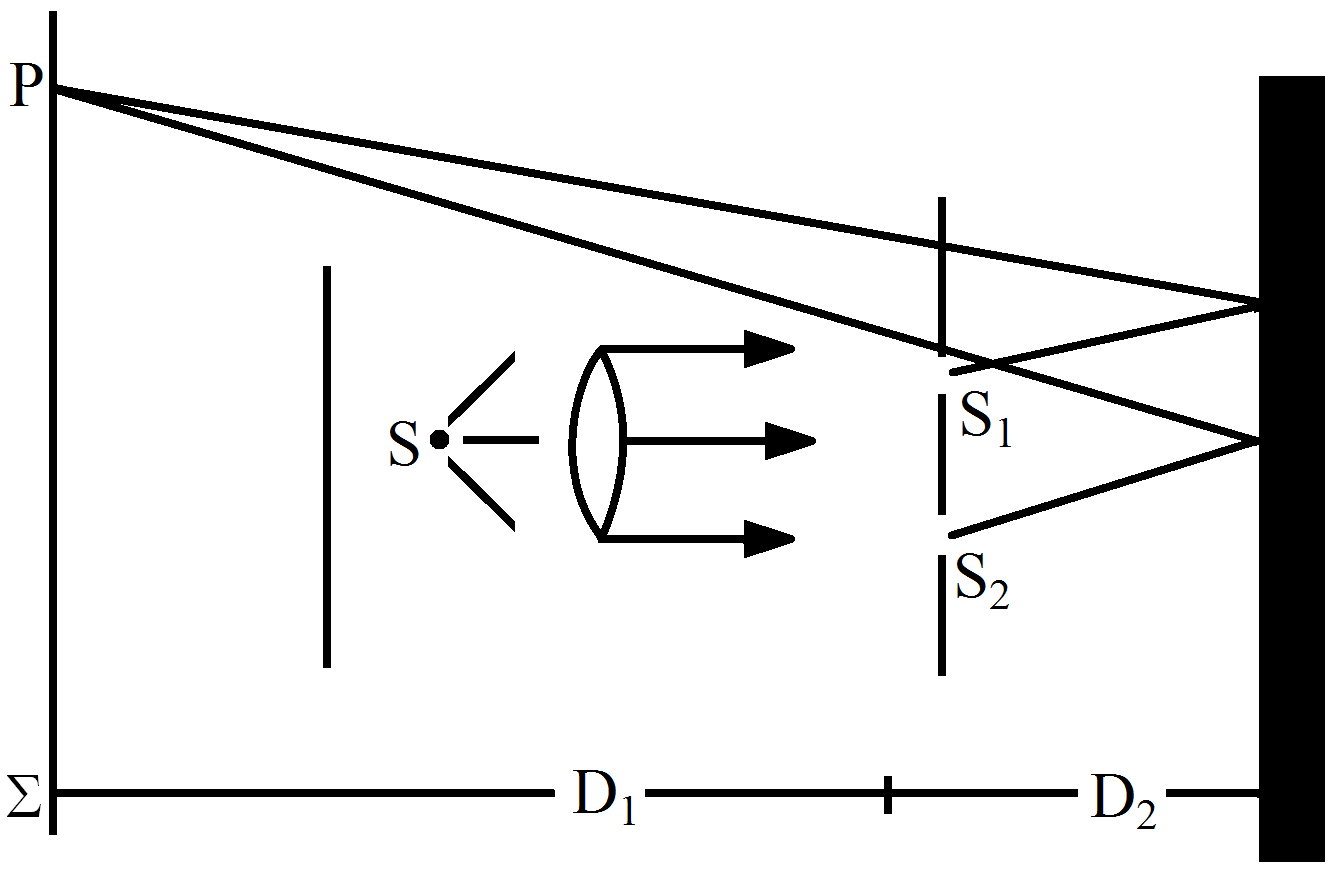
A double slit S1 - S2 is illuminated by a coherent light of wavelength $\lambda$. The slits are separated by a distance d. A plane mirror is placed in front of the double slit at a distance D1 from it and a screen $\sum$ is placed behind the double slit at a distance D2 from it (figure 17-E2). The screen E receives only the light reflected by the mirror. Find the fringe-width of the interference pattern on the screen.

The distance of the field point on the axis of a small dipole is doubled. By what factor will the electric field, due to the dipole change?
When an electron in hydrogen atom jumps from the third excited state to the ground state, how would the de Broglie wavelength associated with the electron change? Justify your answer.
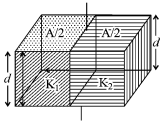
Two dielectric blocks (whose dielectric constants are $K_1$ and $K_2$, respectively) are filled between the plates of a parallel plate capacitor as shown in the figure. What will be the capacitance of the capacitor?
Image
A conducting loop of face-area A and resistance R is placed perpendicular to a magnetic field B. The loop is withdrawn completely from the field. Find the charge which flows through any cross-section of the wire in the process. Note that it is independent of the shape of the loop as well as the way it is withdrawn.