Question
Explain current formed in solid conductors in presence of external electric field.

Answer

Image

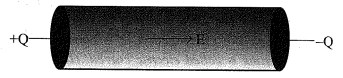
A cylindrical conductor of radius R is shown in the figure, Two thin insulating discs (or dielectric discs) of same radius are placed at the ends of this cylinder. The charges on these discs are $+Q$ and - Q respectively.
An electric field will be created and it is directed from the positive charge $+Q$ towards the negative charge $-Q$.
Due to this electric field, the electrons will be accelerated towards + Q . Such motion continues until the electron neutralizes the charge + Q . This will constitute an electric current.
When this disc is neutralized by the electrons, electrons stop moving. As a result, no current flows. Hence in the considered situation, there will be a current for a short peroid.
Now we can imagine a mechanism where the ends of the cylinder are supplied with fresh charges to make up for any charges neutralized by electrons moving inside the conductor.
In that case, there will be a steady electric field in the conductor. This will result in a continuous current rather than a current for a short period of time.
Electric cells or batteries can maintain a steady electric field that results in a steady current inside the conductor.

Need a full question paper?

Generate a complete, print-ready paper with questions like this in minutes — across 16+ boards, with answer keys.
Start Generating Free

Similar questions

Consider an amplifier circuit using a transistdf. The output power is several times greater than the input power. Where does the extra power come from?
Which currents are produced when an external electric field is applied on a semi-conductor?
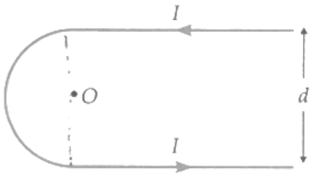
In the given figure, the curved portion is a semi-circle and the straight wires are long. Find the magnetic field at point O. 
Image
The electric current existing in a discharge tube is $2.0\mu\text{A}.$ How much charge is transferred across a cross-section of the tube in 5 minutes?
A right-angled crown glass prism with critical angle 41° is placed before an object, PQ in two positions as shown in the figures (i) and (ii). Trace the paths of the rays from P and Q passing through the prisms in the two cases.
A deuteron and an alpha particle having same momentum are in turn allowed to pass through a magnetic field $\vec{B}$, acting normal to the direction of motion of the particles. Calculate the ratio of the radii of the circular paths described by them.
A wire, carrying a current i, is kept in the x−y plane along the curve $\text{y}=\text{A}\sin\Big(\frac{2\pi}{\lambda}\text{x}\Big).$ A magnetic field B exists in the z direction. Find the magnitude of the magnetic force on the portion of the wire between $\text{x}=0$ and $\text{x}=\lambda.$
Write the formula to determine the refractive index of the material of the prism in the case of minimum deviation.
Why should the objective of a telescope have large focal length and large aperture? Justify your answer.
Distinguish between the terms 'average value' and 'rms value' of an alternating current. The instantaneous current from an a.c. source is I = 5 sin (314 t) ampere.
What are the average and rms values of the current?