Question
Explain current formed in solid conductors in presence of external electric field.

Answer

Image

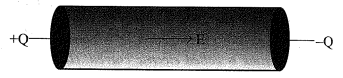
A cylindrical conductor of radius R is shown in the figure, Two thin insulating discs (or dielectric discs) of same radius are placed at the ends of this cylinder. The charges on these discs are $+Q$ and - Q respectively.
An electric field will be created and it is directed from the positive charge $+Q$ towards the negative charge $-Q$.
Due to this electric field, the electrons will be accelerated towards + Q . Such motion continues until the electron neutralizes the charge + Q . This will constitute an electric current.
When this disc is neutralized by the electrons, electrons stop moving. As a result, no current flows. Hence in the considered situation, there will be a current for a short peroid.
Now we can imagine a mechanism where the ends of the cylinder are supplied with fresh charges to make up for any charges neutralized by electrons moving inside the conductor.
In that case, there will be a steady electric field in the conductor. This will result in a continuous current rather than a current for a short period of time.
Electric cells or batteries can maintain a steady electric field that results in a steady current inside the conductor.

Need a full question paper?

Generate a complete, print-ready paper with questions like this in minutes — across 16+ boards, with answer keys.
Start Generating Free

Similar questions

A boy is seated in a revolving chair revolving at an angular speed of 120 revolutions per minute. Two heavy balls form part of the revolving system and the boy can pull the balls closer to himself or may push them apart. If by pulling the balls closer, the boy decreases the moment of inertia of the system from 6kg-m2 to 2kg-m2, what will be the new angular speed?
Under what condition, force on moving charged particle in a magnetic field will be (i) maximum (ii) minimum?
How does the energy stored in a capacitor change if the plates of a charged capacitor are moved farther, the battery remaining connected?
A tightly-wound, long solenoid has n turns per unit length, a radius r and carries a current i. A particle having charge q and mass m is projected from a point on the axis in a direction perpendicular to the axis. What can be the maximum speed for which the particle does not strike the solenoid ?
At what rate should the earth rotate so that the apparent g at the equator becomes zero? What will be the length of the day in this situation?
A small town with a demand of 800kW of electric power at 220V is situated 15km away from an electric plant generating power at 440V. The resistance of the two wire line carrying power is 0.5Ω per km. The town gets power from the line through a 4000-220V step-down transformer at a sub-station in the town.
  1. Estimate the line power loss in the form of heat.
  2. How much power must the plant supply, assuming there is negligible power loss due to leakage?
  3. Characterise the step up transformer at the plant.
Define electric flux. Write its S.I. units. A spherical rubber balloon carries a charge that is uniformly distributed over its surface. As the balloon is blown up and increases in size, how does the total electric flux coming out of the surface change? Give reason.
Can a vector have zero component along a line and still have nonzero magnitude?
Using lens maker’s formula, derive the thin lens formula $\frac{1}{\text{f}}=\frac{1}{\text{v}}-\frac{1}{\text{u}}$ for a biconvex lens.
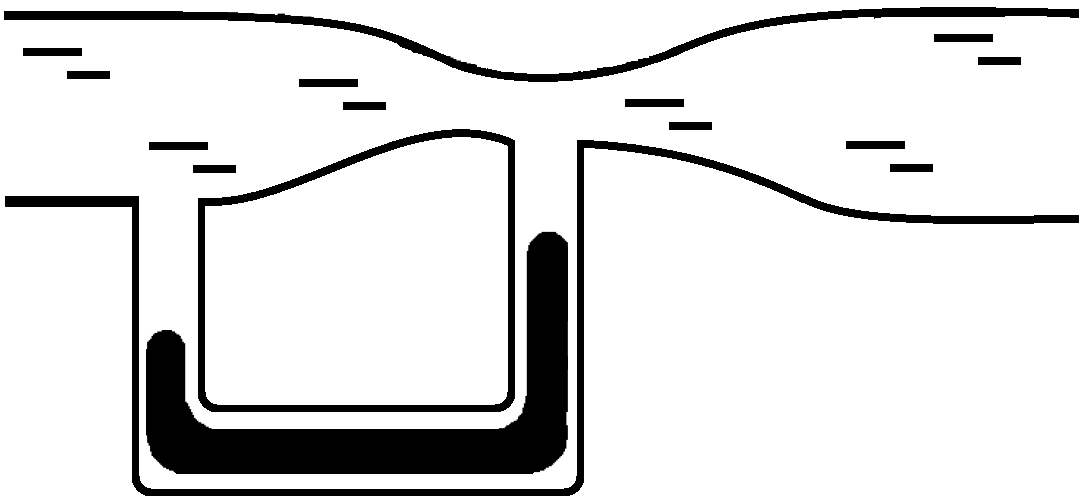
Water flows through the tube shown in  The areas of cross-section of the wide and the narrow portions of the tube are 5cm2 and 2cm2 respectively. The rate of flow of water through the tube is 500cm3/s. Find the difference of mercury levels in the U-tube.