Question
Explain decarboxylation reaction of carboxylic acids.

Need a full question paper?

Generate a complete, print-ready paper with questions like this in minutes — across 16+ boards, with answer keys.

Start Generating Free

Similar questions

What are the characteristics of the transition elements and why are they called transition elements? Which of the d-block elements may not be regarded as the transition elements?
The following data were obtained during the first order thermal decomposition of SO2Cl2 at a constant volume:
SO2Cl2(g)$\rightarrow$SO2(g) + Cl2(g)
Experiment
Time/s-1
Total pressure/atm
1
2
0
100
0.4
0.7
Calculate the rate constant.
(Given: log4 = 0.6021, log2 = 0.3010)
The rate of reaction, 2NO + Cl→ 2NOCl is doubled when concentration of Cl2 is doubled and it becomes eight times when concentration of both NO and Cl2 are doubled. Deduce the order of the reaction.
Arrange the following compound in increasing order of their reactivity in nucleophilic addition reaction.
Benzaldehyde, p-Tolualdehyde, p-Nitrobenzaldehyde, Acetophenone.
State Raoult’s law for solutions of volatile liquid components. Taking a suitable example, explain the meaning of positive deviation from Raoult’s law.
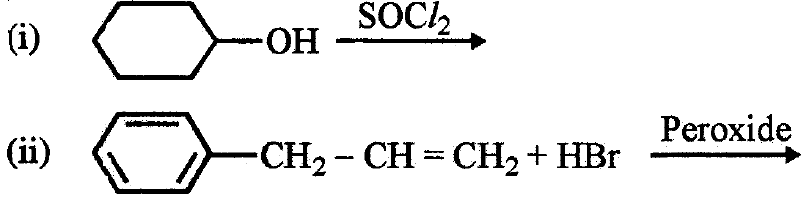
Draw the structure of major monohalo product in each of the following reactions:

Amino acids behave like salts rather than simple amines or carboxylic acids. Explain.
Draw the geometric isomers of $Pt \left( NH _3\right)_2 Cl _2$.
(a) Why in the redox titration of KMnO4 versus oxalic acid do we heat oxalic acid solution before starting the titration?
(b) What are the units of rate of a reaction?
What will be the amount of electricity in Coulomb required to obtain $6$ moles of $H _2$ gas by electrolysis of $H ^{+}$ion solution?