Question
Explain diffraction by a single slit and write down the conditions for central maximum, secondary maxima and minima.

Answer

Image
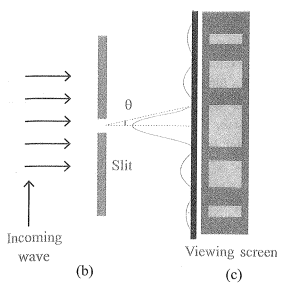
When the double slit in Young's experiment is replaced by a single narrow slit (illuminated by a monochromatic source), a broad pattern with a central bright region is seen.
On both the sides, there are alternate dark and bright regions, the intensity becoming weaker away from the centre. (Fig. (b))
Image
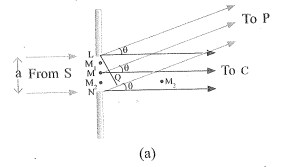
Fig (a) shows a parallel beam of light falling normally, on a single slit LN of width $a$. The diffracted light goes on to meet a screeen. The midpoint of the slit is M .
A straight line through M perpendicular to the slit plane meets the screen at $c$.
We want the intensity at any point P on the screen. As before, straight lines joining P to different points $L, M, N$, etc. can be treated as parallel, making an angle $\theta$ with the normal MC.
Here, the basic idea is to divide the slit into much smaller parts and add their contributions at P with the proper phase difference.
We are treating different parts of the wavefront at the slit as secondary sources. Because the incoming wavefront is parallel to the plane of the slit, these sources are in phase.

Need a full question paper?

Generate a complete, print-ready paper with questions like this in minutes — across 16+ boards, with answer keys.
Start Generating Free

Similar questions

A wire is stretched to reduce its diameter to half. What will be the magnitude of its new resistance?

'Tile earth's magnetic field at a point on its surface is usually characterised by three quantities: (a) declination (bl inclination or dip and (cl horizontal component of the field. These are known as the elements of the earth's magnetic field. At a place, angle between geographic meridian and magnetic meridian is defined as magnetic declination, whereas angle made by the earth's magnetic field with the horizontal in magnetic meridian is known as magnetic dip.

  1. In a certain place, the horizontal component of magnetic field is $\frac{1}{\sqrt{3}}$ times the vertical component. 'Tile angle of dip at this place is:
  1. $\text{Zero}$

  2. $\frac{\pi}{3}$

  3. $\frac{\pi}{2}$

  4. $\frac{\pi}{6}$

  1. The angle between the true geographic north and the north shown by a compass needle is called as:
  1. Inclination.
  2. Magnetic declination.
  3. Angle of meridian.
  4. Magnetic pole.
  1. Tile angles of dip at the poles and the equator respectively are
  1. 30º, 30º
  2. 0º, 90º
  3. 45º, 90º
  4. 90º, 0º 
  1. A compass needle which is allowed to move in a horizontal plane is taken to a geomagnetic pole. It
  1. Will become rigid showing no movement.
  2. Will stay in any position.
  3. Will stay in north-south direction only.
  4. Will stay in east-west direction only. 
  1. Select the correct statement from the following.
  1. The magnetic dip is zero at the centre of the earth.
  2. Magnetic dip decreases as we move away from the equator towards the magnetic pole.
  3. Magnetic dip increases as we move away from the equator towards the magnetic pole.
  4. Magnetic dip does not vary from place to place. 
The phenomenon of bending ofli ght around the sharp corners and the spreading of light within the geometrical shadow of the opaque obstacles is called diffraction of light. The light thus deviates from its linear path. The deviation becomes much more pronounced, when the dimensions of the aperture or the obstacle are comparable to the wavelength of light.

  1. Light seems to propagate in rectilinear path because.
  1. Its spread is very large.
  2. Its wavelength is very small.
  3. Reflected from the upper surface of atmosphere.
  4. It is not absorbed by atmosphere.
  1. ln diffraction from a single slit the angular width of the central maxima does not depends on:
  1. $\lambda$ of light used.
  2. Width of slit.
  3. Distance of slits from the screen.
  4. Ratio of $\lambda$ and slit width.
  1. For a diffraction from a single slit, the intensity of the central point is:
  1. Infinite.
  2. Finite and same magnitude as the surrounding maxima.
  3. Finite but much larger than the surrounding maxima.
  4. Finite and substantially smaller than the surrounding maxima.
  1. Resolving power of telescope increases when:
  1. Wavelength of light decreases.
  2. Wavelength of light increases.
  3. Focal length of eye-piece increases.
  4. Focal length of eye-piece decreases.
  1. ln a single diffraction pattern observed on a screen placed at D metre di stance from the slit of width d metre, the ratio of the width of the central maxima to the width of other secondary maxima is:
  1. 2 : 1
  2. 1 : 2
  3. 1 : 1
  4. 3 : 1
What is power factor? Explain.
In one of the exercises to strengthen the wrist and fingers, a person squeezes and releases a soft rubber ball. Is the work done on the ball positive, negative or zero during compression? During expansion?
A kid of mass M stands at the edge of a platform of radius R which can be freely rotated about its axis. The moment of inertia of the platform is I. The system is at rest when a friend throws a ball of mass m and the kid catches it. If the velocity of the ball is v horizontally along the tangent to the edge of the platform when it was caught by the kid, find the angular speed of the platform after the event.
Explais the arrangements for conducting an experimental study of the photoelectric effect.
A silver ball of radius 4.8cm is suspended by a thread in a vacuum chamber. Ultraviolet light of wavelength 200 run is incident on the ball for some time during which a total light energy of 1.0 × 10⁻⁷J falls on the surface. Assuming that on the average one photon out of every ten thousand is able to eject a photoelectron, find the electric potential et the surface of the bell assuming zero potential at infinity. What is the potential at the centre of the bell?
By mistake, an eye surgeon puts a concave lens in place of the lens in the eye after a cataract operation. Will the patient be able to see clearly any object placed at any distance?
Electrostatic potential energy of a system of point charges is defined as the total amount of work done in bringing the different charges to their respective positions from infinitely charge mutual separations. The work is stored in the system of two point charges in the form of electrostatic potential energy U of the system. Electric potential difference between any points A and B in an electric field is the amount of work done in moving a unit positive test charge from A to B along any path agents the electrostatic force $\text{V}_\text{B}-\text{V}_\text{A}=\frac{\text{W}_\text{AB}}{\text{q}_\text{o}}=\int\vec{\text{E}}.\text{dl}.$

  1. A test charge is moved from lower potential point to a higher potential point. The potential energy of test charge wiII.
  1. Remain the same.
  2. Increase.
  3. Decrease.
  4. Become zero.
  1. Which of the following statement is not true?
  1. Electrostatic force is a conservative force.
  2. Potential energy of charge q at a point is the work done per unit charge in bringing a charge from any point to infinity.
  3. Spring force and gravitational force are conservative force.
  4. Both (a) and (c).
  1. Work done in moving a charge from one point to another inside a uniformly charged conducting sphere is:
  1. Always zero.
  2. Non-zero.
  3. May be zero.
  4. None of these.
  1. The work done in bringing a unit positive charge from infinite distance to a point at distance x from a positive charge Q is W. Then the potential $\phi$ at that point is:
  1. $\frac{\text{WQ}}{\text{x}}$

  2. W

  3. $\frac{\text{W}}{\text{x}}$

  4. WQ

  1. If $1\mu\text{C}$ charge is shifted from A to B and it is found that work done by an external force is $40\mu\text{J}.$ ln doing so against electrostatics force, the potential difference VA - VB is:
  1. 40V
  2. -40V
  3. 20V
  4. -60V