Question
Explain different types of isomerism in amines.

Answer

SELF

Need a full question paper?

Generate a complete, print-ready paper with questions like this in minutes — across 16+ boards, with answer keys.

Start Generating Free

Similar questions

The rate constant for the decomposition of $N_2O_5$ at various temperatures is given below:
$T/^\circ C$ $0$ $20$ $40$ $60$ $80$
$105 \times k/s-1$ $0.0787$ $1.70$ $25.7$ $178$ $2140$
Draw a graph between ln $k$ and $1/T$ and calculate the values of $A$ and $E_a$. Predict the rate constant at $30^\circ$ and $50^\circ C.$
What is the role of adsorption in heterogenous catalysis?
Discuss the general characteristics of Group $15$ elements with reference to their electronic configuration, oxidation state, atomic size, ionisation enthalpy and electronegativity.
Answer the following question:
0.6mL of acetic acid $(CH_3COOH)$, having density $1.06g mL^{-1}$​​​​​​​, is dissolved in $1$ litre of water. The depression in freezing point observed for this strength of acid was $0.0205^\circ C$. Calculate the van’t Hoff factor and the dissociation constant of acid.
  1. Although nitrogen and chlorine have nearly same electronegativity yet nitrogen forms hydrogen bonding while chlorine does not. Why?
  2. What happens when $F_2$ reacts with water?
  3. Write the name of the gas evolved when $Ca_3P_2$ is dissolved in water.
  4. Write the formula of a noble gas species which is isostructural with $IBr_2$.
  5. Complete the equation:
$[Fe(H_2O)_6]^{2+}$ + NO $\longrightarrow$
  1. Account for the following:
  1. Thermal stability of water is much higher than that of $H_2S$.
  2. Anhydrous aluminium chloride acts as a catalyst.
  3. White phosphorus is more reactive than red phosphorus.
  1. Draw the structures of (i) $H_3PO_3$​​​​​​​ and (ii) $XeOF_4$​​​​​​​.
i. Name the element of 3d transition series which shows maximum number of oxidation states. Why does it show so?
ii. which transition metal of 3 d series has positive $E ^{\circ}\left( M ^{2+} / M \right)$ value and why?
iii. Out of $Cr ^{3+}$ and $Mn ^{3+}$, which is a stronger oxidizing agent and why?
iv. Name a member of the lanthanoid series which is well known to exhibit +2 oxidation state.
v. Complete the following equation:
$MnO_4^{-}+8 H^{+}+5 e^{-} \rightarrow$
a. Amongst the following, the most stable complex is:
i. $\left[ Fe \left( H _2 O \right)_6\right]^{3+}$
ii. $\left[ Fe \left( NH _3\right)_6\right]^{3+}$
iii. $\left[ Fe \left( C _2 O _4\right)_3\right]^{3-}$
iv. $\left[ FeCl _6\right]^{3+}$
b. What will be the correct order for the wavelength of absorption in the visible region for the following:
$
\left[Ni\left(NO_2\right)_6\right]^{4-},\left[Ni\left(NH_3\right)_6\right]^{2+},\left[Ni\left(H_2 O\right)_6\right]^{2+}
$
Derive the Nernst equation and explain how $E_{\text {cell }}^{\circ}$ depends on concentration of ions.
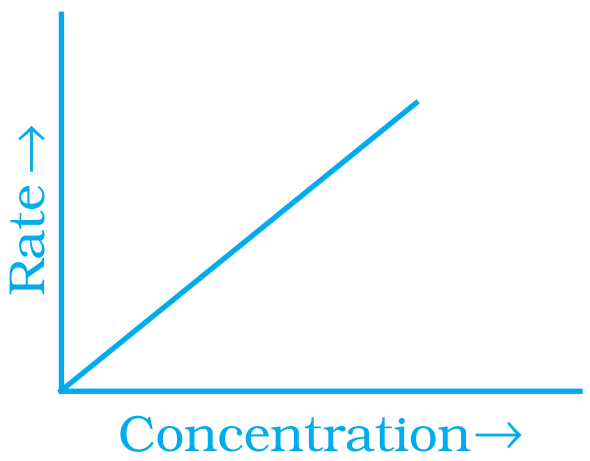
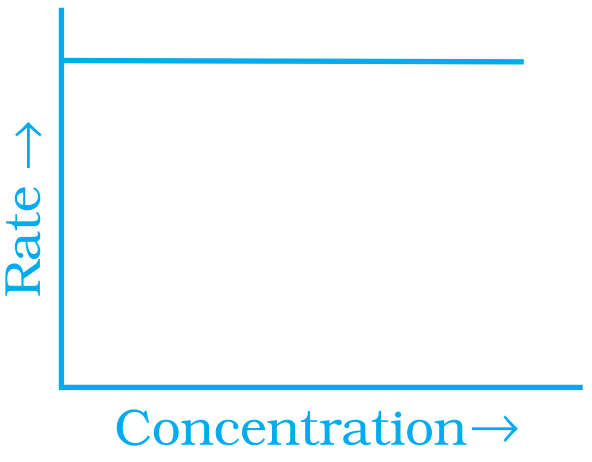
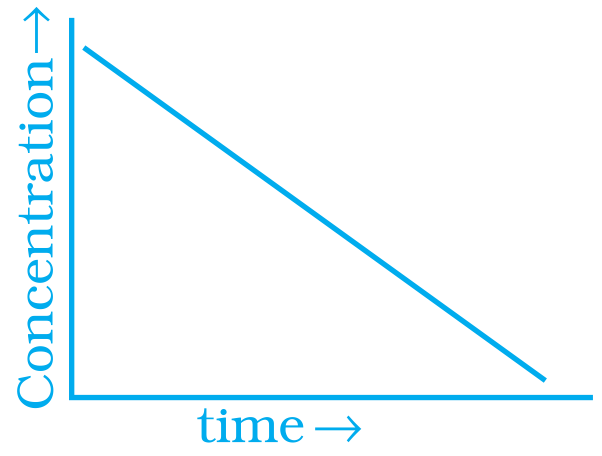
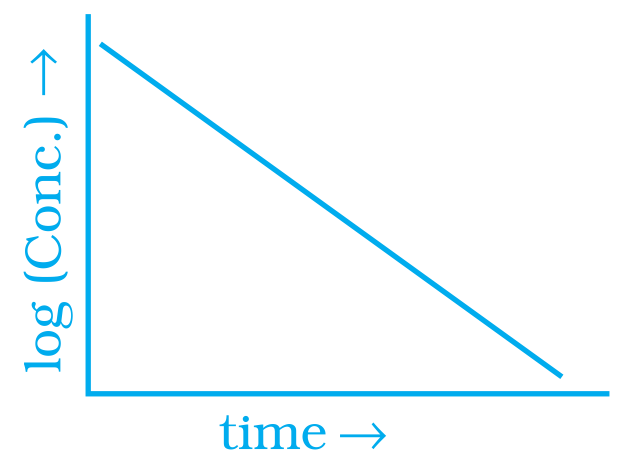
Match the graph given in Column I with the order of reaction given in Column II. More than one item in Column I may link to the same item of Column II.
 
Column I
 
Column II
(i)
 
 
(ii)
(a)
$I^{st}$ order
(iii)
(b)
Zero order
(iv)