Question
Explain double fertilisation and trace the post-fertilisation events in sequential order leading to seed formation in a typical dicotyledonous plant.

Answer

Double fertilisation:

  • On reaching synergid, pollen tube releases the two male gametes into cytoplasm of synergid.
  • One of the male gamete fuses with egg nucleus to form a diploid cell called zygote. This event is called syngamy.
  • Other male gamete fuses with polar nuclei at the centre to produce a triploid primary endosperm nucleus (PEN). This is termed as triple fusion. As syngamy and triple fusion take place simultaneously in the embryo sac, it is termed as double fertilisation.
  • The central cell after triple fusion forms primary endosperm cell (PEC) which later develops into endosperm.
  • The zygote later develops into an embryo.

Following are the post-fertilisation events:

  1. Development of embryo: Embryo develops in fertilised ovule, from the zygote. The early stages of embryo development from a zygote is known as embryogeny. The formation of embryo starts only after certain amount of endosperm formation to assure the nutrition supply, for development and growth of embryo.
  2. Development of seeds: Refer to Basic Concepts Point 10 (Embryogeny in Dicots). As a result of double fertilisation number of changes takes place in an ovule due to which ovule is converted into seeds.

Need a full question paper?

Generate a complete, print-ready paper with questions like this in minutes — across 16+ boards, with answer keys.
Start Generating Free

Similar questions

Answer the following questions:
Explain the events that occur in a graafian follicle at the time of ovulation and thereafter.
Answer the following questions:
Explain the menstrual phase in a human female. State the levels of ovarian and pituitary hormones during this phase.
  1. State one difference and one similarity between geitonogamy and xenogamy.
  2. Explain any three devices developed in flowering plants to discourage self pollination and encourage cross-pollination.
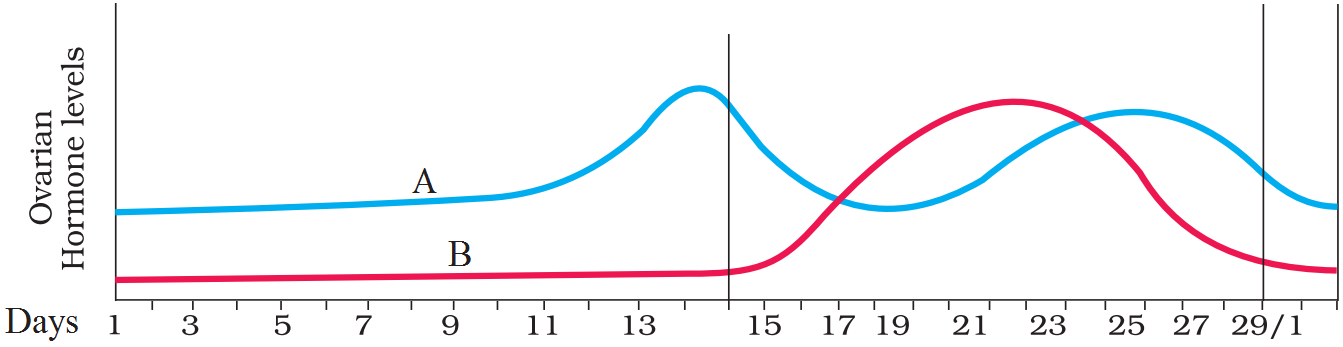
The graph given below shows the variation in the levels of ovarian hormones during various phases of menstrual cycle:

Specify the source of the hormone marked in the diagram.

Answer the following questions:
Explain the role of pituitary and the ovarian hormones in menstrual cycle in human females.
During the biology class on theories of evolution, the teacher was telling about Lamarckism. Katy was confused after listening to it and went to her teacher to clear her doubts. She asked if characters can be passed to generations, then why she does not have the tatoo that her mother has on her arm. The teacher smiled and told Katy that this is the reason why Lamarck's theory was rejected. The teacher explained her the other theories as well.
  1. Name the book in which Lamarckism was explained.
  2. What are the three factors of this theory?
  3. What are the other theories of evolution?
  4. What are the values shown by teacher?

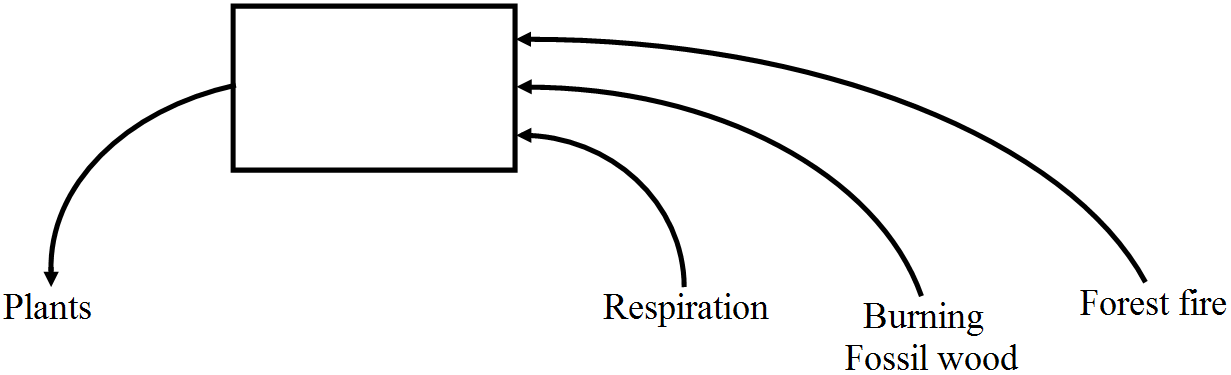
The above diagram shows a simplified biogeochemical cycle.

  1. Name the compound whose cycle is depicted.
  2. In what way do vehicles add this compound to atmosphere?
  3. What adverse effect does its excess have on the environment?
  4. Cite an event which depicts this effect in the modern times.
  5. Suggest two ways of reducing this effect.
Explain why a recessive allele is unable to express itself in a heterozygous state.
  1. What is meant by ecological succession? How does it occur? Explain.
  2. Differentiate between Primary and Secondary succession.
What functions do the female reproductive system perform?