Electric Charges and Fields — Physics STD 12 Science — Question
Gujarat BoardEnglish MediumSTD 12 SciencePhysicsElectric Charges and Fields3 Marks
Question
Explain Electric Flux.
✓
Answer
►The number of electric field lines passing through a closed surface in an electric field is called electric flux. ►Suppose the electric field is $\overrightarrow{ E }$ and the area of the closed - surface is $\Delta S$, then the electric flux associated with this surface is given by $\phi=\overrightarrow{ E } \cdot \overrightarrow{\Delta S }$
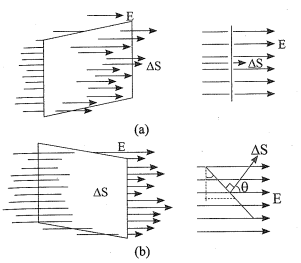
►As shown Fig. (a) electric flux associated with placing the electric field perpendicular to a small planar element of area $\Delta S$ is $\begin{aligned} \phi & = E \Delta S \cos \theta \text { (But } \overrightarrow{ E } \| \overrightarrow{\Delta S } \text { So, } \theta=0 \text { ) } \\ \therefore \quad \phi & = E \Delta S \text { (maximum) } \end{aligned}$ ►Now if we tilt the area $\Delta S$ by an angle of $\theta$ then the number of field lines passing through the area segment $\Delta S$ is Fig. (b) will be less than before. In this case the electric flux associated with the plane is found to be $\phi= E \Delta S \cos \theta$
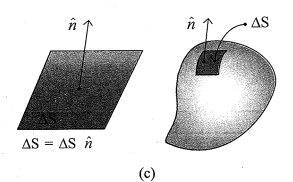
►If $\theta=90^{\circ}(\overrightarrow{ E } \perp \overrightarrow{\Delta S })$ no field line passes through the plane. As a result, zero electric flux associated with plane $\phi= E \Delta S \cos 90^{\circ}=0$ ►As shown in Fig. (c), a curved surface is placed in an electric field. ►To obtain the electric flux associated with this curved surface; consider this surface divided into many micro-sections. Each continent is so subtle that each continent can be considered a plane. ►The electric flux associated with any of the microscopic sections is $\therefore \Delta \phi=\overrightarrow{ E } \cdot \overrightarrow{\Delta S }$ ►Now if the total flux is to be obtained similarly the electric fluxes associated with all the subsections are obtained and then summed up. Hence, the total electric flux through the curve $\therefore \phi=\sum \overrightarrow{ E } \cdot \overrightarrow{\Delta S }$ ►Here, the electric field $\vec{E}$ is assumed to be constant for small piece. Now if $\Delta S \rightarrow 0$ is taken then the given sum turns into integral. $\therefore \phi=\int \overrightarrow{ E } \cdot \overrightarrow{\Delta S }$ ►Electric flux is a scalar quantity Unit $\frac{ Nm ^2}{ C }$ OR Vm ►Dimensional Formula : $M ^1 L^3 T^{-3} A^{-1}$
Need a full question paper?
Generate a complete, print-ready paper with questions like this in minutes — across 16+ boards, with answer keys.