Question
Explain electric potential energy difference and discuss its important points.

Answer

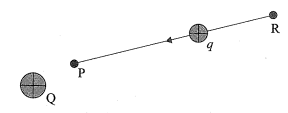
Image

→As shown in the figure, consider a charge $Q$ at the origin (of the cartesian coordinate system.) At each point in the electric field of charge Q , particle having charge $q$ possesses some potential energy.
→Work needs to be done on this charge $q$, in taking it from point R (initial positionl) to point P (final position.)
→This work increase the potentical energy of $q$ which will be equal to the potential energy difference between points R and P .
So, the potential energy difference
$\Delta U=U_P-U_R=W_{R P}$
→Here, the displacement is in the opposite direction to the electric force, hence the work done by electric force is negative $\left(- W _{ RP }\right)$, which is called electric potential energy at point $P$ with respect to point $R$.
→For the electric field of a random electric charge, the electric potential energy difference, between two points, can be defined as the work done by external force in taking the given charge $q$ from one point to the other point without acceleration.
Important points :
(1) The right hand side term of the equation $\Delta U$ $= U _{ P }- U _{ R }$ shows that the work done by the electric field to move the electric charge from one point to another in the electric field depends only on the intial position and the final position. It does not depend on the path joining them, which is a fundamental characteristic of conservative force.
(2) There is no importance of absolute value of electrostatic potential energy. It is only the difference of electrostatic potential energy that matters.
(3) If a random constant $\alpha$ is added to the potential energy at each point, it doesn't make any difference to the potential energy difference between two points. Means, it will be :
$\left( U _{ P }+\alpha\right)-\left( U _{ R }+\alpha\right)= U _{ P }- U _{ R }$
(4) For the sake of ease, the potential energy at infinite distance is taken zero. Suppose, Point $R$ is at infinity. then, $U _{ R }= U _{\infty}=0$
$\therefore W _{ RP }= W _{\infty P }= U _{ P }- U _{\infty}= U _{ P }$
(5) The potential energy of a charge $q$ at any point, is the work done by external force in bringing that charge from infinite distance to that point only.

Need a full question paper?

Generate a complete, print-ready paper with questions like this in minutes — across 16+ boards, with answer keys.
Start Generating Free

Similar questions

The neutron separation energy is defined as the energy required to remove a neutron from the nucleus. Obtain the neutron separation energies of the nuclei ${ }_{20}^{41} Ca$ and ${ }_{13}^{27} Al$ from the following data:
$ m \left({ }_{20}^{40} C a\right)=39.962591 u$
$m \left({ }_{20}^{41} C a\right)=40.962278 u$
$m \left({ }_{13}^{26} A l\right)=25.986895 u$
$m \left({ }_{13}^{27} A l\right)=26.981541 u $
Does focal length of a lens depend on the colour of the light used? Does focal length of a mirror depend on the colour?
When a photon is emitted from an atom, the atom recoils. The kinetic energy of recoil and the energy of the photon come from the difference in energies between the states involved in the transition. Suppose, a hydrogen atom changes its state from n = 3 to n = 2. Calculate the fractional change in the wavelength of light emitted, due to the recoil.
  1. State the principle of working of a meter bridge.
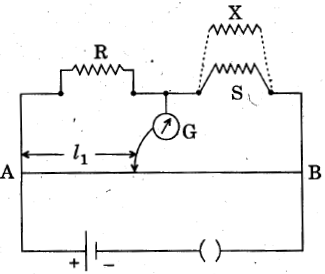
  2. In a meter bridge balance point is found at a distance $l_1$ with resistances R and S as shown in the figure.


When an unknown resistance X is connected in parallel with the resistance S, the balance point shifts to a distance $l_2$. Find the expression for X in terms of $l_1, l_2$ and S.
Two concentric circular coils, one of small radius $r_1$ and the other of large radius $r_2$, such that $r_1 \ll r_2$, are placed co-axially with centres coinciding. Obtain the mutual inductance of the arrangement.
A convex lens produces a double size real image when an object is placed at a distance of 18cm from it. Where should the object be placed to produce a triple size real image?
Using Bohr’s postulates, obtain the expression for the total energy of the electron in the stationary states of the hydrogen atom. Hence draw the energy level diagram showing how the line spectra corresponding to Balmer series occur due to transition between energy levels.
A spherical volume contains a uniformly distributed charge of density $2.0 \times 10^{-4}Cm^{-3}.$ Find the electric field at a point inside the volume at a distance 4.0cm from the centre.
In a series LCR circuit connected to an ac source of variable frequency and voltage v $v_m= \sin, $ draw a plot showing the variation of current (I) with angular frequency ($\omega$) for two different values of resistance R1 and R2(R1 > R2 ). Write the condition under which the phenomenon of resonance occurs. For which value of the resistance out of the two curves, a sharper resonance is produced? Define Q-factor of the circuit and give its significance.
Write any two distinguishing features between conductors, semiconductors and insulators on the basis of energy band diagrams.