Bihar BoardEnglish MediumSTD 12 SciencePhysicsSEMICONDUCTOR ELECTRONICS: MATERIALS, DEVICES AND SIMPLE CIRCUITS2 Marks
Question
Explain electricity conduction in intrinsic semi-conductors.
✓
Answer
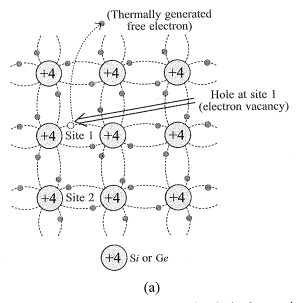
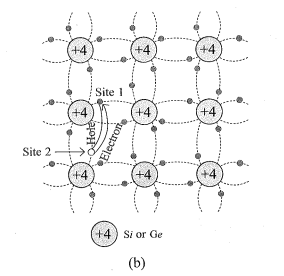
→As shown in Fig. (a), Suppose there is a hole at site-1. The movement of holes can be visualised as shown in the Fig (b). →An electron from the covalent bond at site-2, may jump to the vacant site-1. (hole) →Thus, after such a jump, the hole is at site-2 and the site-1 has now an electron. Therefore, apparently, the hole has moved from site-1 to site-2. (So, the directions of motion of a hole and an electron are opposite). →Note that the electron originally set free (Fig. a) is not involved in the process of hole motion. →The free electron moves completely independently as conduction electron and gives rise to an electron current, I under an applied electric field. →Remember that the motion of hole is only a convenient way of describing the actual motion of bound electrons, whenever there is an empty bond anywhere in the crystal. →Under the action of an electric field, these holes move towards negative potential giving the hole current, $I _h$. →The total current, I is thus the sum of electron current $I _e$ and the hole current $I _h$ : $\therefore I = I _e+ I _h$ .......(1) →Apart from the process of generation of conduction electrons and holes, a simultaneous process of recombination occurs in which these electrons recombine with holes. →At equilibrium, the rate of generation is equal to the rate of recombination of charge carries. The recombination occurs due to an electron colliding with a hole.
Need a full question paper?
Generate a complete, print-ready paper with questions like this in minutes — across 16+ boards, with answer keys.