Question
Explain electrolysis of concentration aqueous solution of NaCl

Answer

→ During the electrolysis of aqueous sodium chloride solution, the products are $NaOH , Cl _2$ and $H _2$.
→ In this case besides $Na ^{+}$and $Cl ^{-}$ions we also have $H ^{+}$and $OH ^{-}$ions along with the solvent molecules, $H _2 O$.
→ At the cathode there is competition between the following reduction reactions :
$
\begin{array}{l}
Na ^{+}( aq )+ e ^{-} \rightarrow Na ( s ) E _{\text {(cell) }}^{\ominus}=-2.71 V \\
H ^{+}( aq )+ e ^{-} \rightarrow \frac{1}{2} H _2(g) E _{\text {(cell) }}^{\ominus}=0.00 V
\end{array}
$
→ The reaction with higher value of $E ^{\ominus}$ is preferred and, therefore the reaction at the cathode during electrolysis is :
$
H ^{+}( aq )+ e ^{-} \rightarrow \frac{1}{2} H _2(g)...(1)
$
but $H ^{+}( aq )$ is produced by the dissociation of $H _2 O$ i.e.,
$
H _2 O (l) \rightarrow H ^{+}( aq )+ OH ^{-}( aq )
$...(2)
Therefore, the net reaction at the cathode may be written as the sum of (1) and (2) and we have
$
H _2 O ( l )+ e ^{-} \rightarrow \frac{1}{2} H _2(g)+ OH ^{-}
$
At the anode the following oxidation reactions are possible :
$
\begin{array}{l}
Cl ^{-}( aq ) \rightarrow \frac{1}{2} Cl _2(g)+ e ^{-} E _{\text {(cell) }}^{\ominus}=1.36 V \ldots \ldots . .(3) \\
2 H _2 O ( l ) \rightarrow O _2(g)+4 H ^{+}( aq )+4 e ^{-} E _{\text {(cell) }}^{\ominus}=1.23 V
\end{array}
$
→ The reaction at anode with lower value of $E ^{\ominus}$ is preferred and therefore, water should get oxidised in preference to $Cl ^{-}$(aq). However, on account of over potential of oxygen, reaction (3) is preferred. Thus, the net reactions may be summarised as:
$NaCl ( aq ) \xrightarrow{ H _2 O } Na ^{+}( aq )+ Cl ^{-}( aq )$
Cathode : $H _2 O (l)+ e ^{-} \rightarrow \frac{1}{2} H _2(g)+ OH ^{-}( aq )$
Anode : $Cl ^{-}( aq ) \rightarrow \frac{1}{2} Cl _2(g)+ e ^{-}$
Net reaction :
$
\begin{array}{l}
NaCl ( aq )+ H _2 O ( l ) \rightarrow Na ^{+}( aq )+ OH ^{-}( aq )+\frac{1}{2} H _2(g)+\frac{1}{2} Cl _2(g)
\end{array}$

Need a full question paper?

Generate a complete, print-ready paper with questions like this in minutes — across 16+ boards, with answer keys.

Start Generating Free

Similar questions

Nalorphene (C19H21NO3), similar to morphine, is used to combat withdrawal symptoms in narcotic users. Dose of nalorphene generally given is 1.5 mg. Calculate the mass of 1.5 – 10–3 m aqueous solution required for the above dose.
When a chromite ore (A) is fused with sodium carbonate in free excess of air and the product is dissolved in water, a yellow solution of compound (B) is obtained. After treatment of this yellow solution with sulphuric acid,compound (C) can be crystallised from the solution. When compound (C) is treated with KCl, orange crystals of compound (D) crystallise out. Identify A to D and also explain the reactions.
  1. Draw the structures of all isomeric alcohols of molecular formula C5H12O and give their IUPAC names.
  2. Classify the isomers of alcohols in question 11.3 (i) as primary, secondary and tertiary alcohols.
The electrical resistance of a column of 0.05 M KOH solution of diameter 1 cm and length 45·5 cm is 4.55 $\times$ 103 ohm. Calculate its molar conductivity.
Complete the following chemical equations:
  1. Cr2O72- + 6 Fe2++ 14H+
  2. 2CrO2-+ 2H+
  3. 2MnO-+ 5C2O42- + 16H+
Explain the following in one or two sentences:
Allyl chloride is hydrolysed more readily than n-propyl chloride.
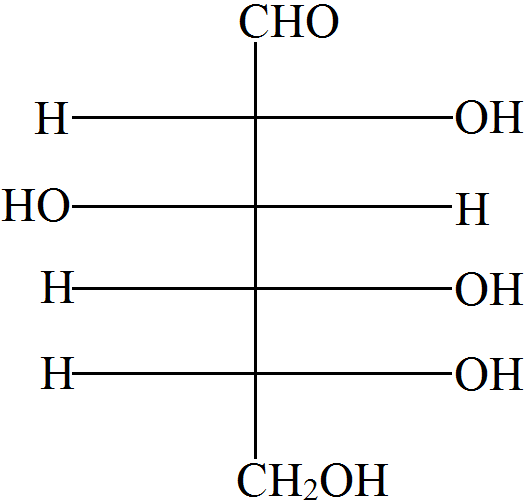
The Fischer projection of D-Glucose is given alongside.
Give the Fischer projection of L-Glucose.

If one strand of a DNA has the sequence -ATGCTTCA-, what is the sequence of the bases in the complementary strand?
Explain the following observations:
There is a close similarity in physical and chemical properties of the 4d and 5d series of the transition elements, much more than expected on the basis of usual family relationship.
Discuss in details the oxidation of methyl ketones by haloform reaction. And also mention that for detection of which type of group this reaction is useful?