Maharashtra BoardEnglish MediumSTD 12 ScienceChemistryElectrochemistry4 Marks
Question
Explain electrolysis of molten NaCl.
✓
Answer
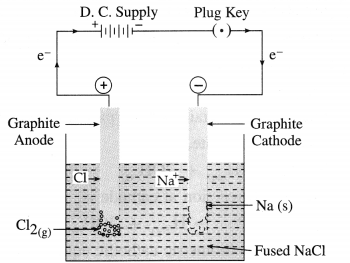
(1) Construction of an electrolytic cell : It consists of a vessel containing molten (fused) NaCl. Two graphite (carbon) inert electrodes are dipped in it, and connected to an external source of direct electric current (battery). The electrode connected to a negative terminal of the battery is a cathode and that connected to a positive terminal is an anode.
(2) Working of the cell :
(A) In the external circuit, the electrons flow through the wires from anode to cathode of the cell.
(B) The fused NaCl dissociates to form cations $(Na^+)$ and anions $(Cl^–).$
$NaCl _{\text {(fused) }} \longrightarrow Na _{(1)}^{+}+ Cl _{( l )}^{-}$
(C) Reactions in electrolytic cell :
(i) Reduction half reaction at cathode : The $Na^+ $ ions get reduced by accepting electrons from a cathode supplied by a battery and form metallic sodium.
$Na ^{+}+ e ^{-} \longrightarrow Na _{( s )}$ (reduction)
(ii) Oxidation half reaction at anode : The $Cl^– $ ions get oxidised by giving up electrons to the anode forming neutral Cl atoms in the primary process, and these Cl atoms combine forming $Cl_2 $ gas in the secondary process.
$2 Cl ^{-} \longrightarrow Cl _{( g )}+ Cl _{( g )}+2 e ^{-}$(Primary oxidation half reaction)
${2 Cl _{( g )} \longrightarrow Cl _{2( g )}}\text { (Secondary process) }$
$ 2 Cl ^{-} \longrightarrow Cl _{2( g )}+2 e ^{-}$ (Overall oxidation at anode)
The released electrons in the anodic oxidation half reaction return to battery through the metallic wires.
Net cell reaction : In order to maintain the electrical neutrality, the number of electrons gained at cathode must be equal to the number of electrons released at anode. Hence the reduction half reaction is multiplied by 2 and both reactions, oxidation half reaction and reduction half reaction are added to obtain a net cell reaction.
$ 2 Na _{( l )}^{+}+2 e ^{-} \longrightarrow 2 Na _{( s )} \text { (Reduction half reaction) }$
$2 Cl _{( l )}^{-} \longrightarrow Cl _{2( g )}+2 e ^{-} \text {(Oxidation half reaction) }$
$2 Na _{( l )}^{+}+2 Cl _{( (l) }^{-} \longrightarrow 2 Na _{( s )}+ Cl _{2( g )} $(Overall reaction)
Results of electrolysis :
A molten silvery white Na is formed at cathode which floats on the surface of molten NaCl.
A pale green $Cl_2 $ gas is liberated at anode.
Need a full question paper?
Generate a complete, print-ready paper with questions like this in minutes — across 16+ boards, with answer keys.