Question
Explain : Electrostatic shielding.

Answer

Image
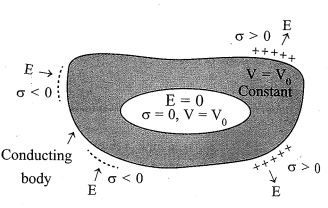
Consider a conductor with a cavity as shown in the figure.
The shape and size of the cavity can be any.
There is no charge in the cavity.
No matter what external field such a conductor is placed in the electric field in the cavity is zero.
Even if the conductor is charged, all charges, reside only on the outer surface of conductor with cavity.
Like this, there is no effect of the external electric field or electric charge on the cavity. which means the cavity remains shielded from outside charge and external electric field, which is known as electrostatic shielding.
This effect can be made of use in protecting sensitive equipments from outside electrical influence.
E.g. in monsoon season, if we are sitting in a car and lightening strikes, we should close the doors and windows of the car. By doing this, we happen to be in the cavity of car and we are protected due to electro static shielding.
Need a full question paper?

Generate a complete, print-ready paper with questions like this in minutes — across 16+ boards, with answer keys.

Start Generating Free

Similar questions

A sphere of mass m rolls on a plane surface. Find its kinetic energy at an instant when its centre moves with speed v.
The current in the forward bias is known to be more $(\sim\mu\text{A})$ than the current in the reverse bias $(\sim\mu\text{A})$.What is the reason, then, to operate the photodiode in reverse bias?
The electric current in a charging R-C circuit is given by $\text{i}=\text{i}_0\text{e}^{-\frac{\text{t}}{\text{RC}}}$ where $\text{i}_0,$ R and C are constant parameters of the circuit and t is time. Find the rate of change of current at
  1. t = 0.
  2. t = RC.
  3. t = 10RC.
Work function of aluminium is 4.2eV. If two photons, each of energy 2.5eV, are incident on its surface, will the emission of electrons take place? Justify your answer.
What is the longest wavelength of photon that can ionize a hydrogen atom in its ground state? Specify the type of radiation.
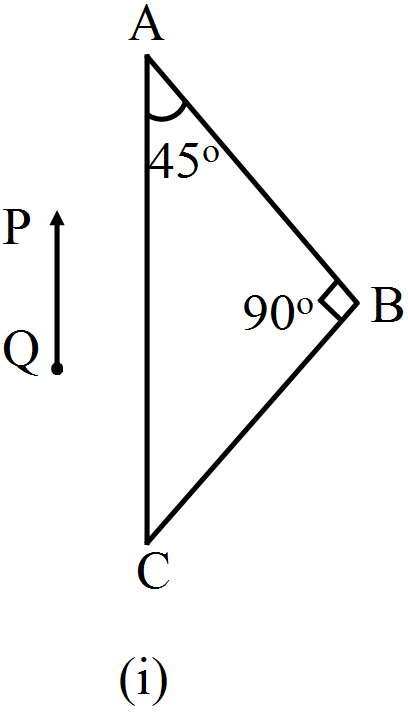
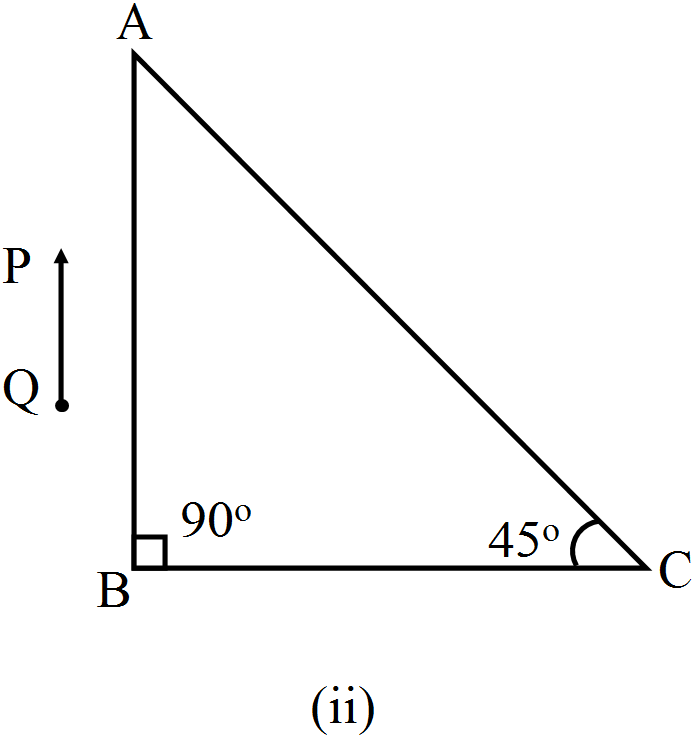
A right-angled crown glass prism with critical angle 41° is placed before an object, PQ in two positions as shown in the figures (i) and (ii). Trace the paths of the rays from P and Q passing through the prisms in the two cases.

Determine the distance of closest approach when an alpha particle of kinetic energy 4·5 MeV strikes a nucleus of Z = 80, stops and reverses its direction.
Is it true that the reaction of a gravitational force is always gravitational, of an electromagnetic force is always electromagnetic and so on?
What is the principle of superposition of charges?
In a Van de Graaff type generator a spherical metal shell is to be a 15 × 106V electrode. The dielectric strength of the gas surrounding the electrode is 5 × 107Vm–1. What is the minimum radius of the spherical shell required? (You will learn from this exercise why one cannot build an electrostatic generator using a very small shell which requires a small charge to acquire a high potential.)