Question
Explain emf, potential difference and internal resistance of cell and derive the relation between them. (or derive the relation between emf, potential difference and internal resistance of the cell.)
Answer

Image
Image
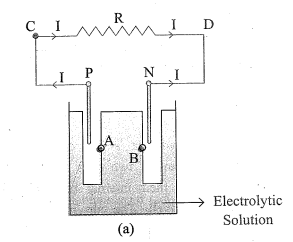
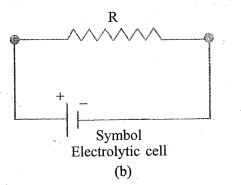
The figure shows the electrolytic cell. Electrolytic cell is used to maintain a steady current in an electric circuit.
As shown in the figure, two electrodes, positive (P) and negative (N) are immersed in an electrolytic solution.
Because of being dipped in the solution, the electrodes exchange charges with the electrolyte.
The potential difference between the positive electrode and the adjacent point A is $V _{+}$and the potential difference between negative electrode to the adjacent point B is $- V _{-}$.
So, the potential difference between P and N is $V_{+}-\left(-V_{-}\right)=V_{+}+V_{-}$
This potential difference is called the electromotive force (emf) of the cell and it is denoted by $\varepsilon$.
$\therefore \varepsilon= V _{+}+ V _{-}>0$
→Definition of emf : The potential difference between two electrodes when no current is flowing through the cell is called the emf of the cell.
As shown in the figure, consider a resistor R connected across the cell and current I flows across R from C to D and current in electrolyte current flows from N to P . clearly, across the electrolyte the same current flows through the electrolyte.
The electrolyte through which a current flows has a finite resistance $r \&$ it is called the internal resistance.
→Case I : $R =\infty$ (infinite)
According to ohm's law
$I =\frac{ V }{ R } \rightarrow I =0$
where V is the potential difference between P and N and it is called terminal voltage (or voltage) of the cell.
The potential difference between P and N , V (terminal voltage or voltage)
$=$ Potential difference between P and A
+ Potential difference between A and B
+ Potential difference between B and N
$\begin{aligned}
V & = V _{+}+ V _{-} \\
\therefore V & =\varepsilon
\end{aligned}$
Thus, emf $\varepsilon$ is the potential difference between the positive and negative electrodes in an open circuit i.e when no current is flowing through the cell.
→Case II : $R =$ Finite
when $R$ is finite, electric current flows through the cell. In that case the potential difference between P and N is
$\begin{aligned}
V & = V _{+}+ V _{-}- I r \\
\therefore \quad V & =\varepsilon- I r
\end{aligned}$
The negative sign in the expression (Ir) for the potential difference between A and B . This is because the current I flows from B to A in the electrolyte.

Need a full question paper?

Generate a complete, print-ready paper with questions like this in minutes — across 16+ boards, with answer keys.
Start Generating Free

Similar questions

  1. Draw circuit diagram and explain the working of a zener diode as a dc voltage regulator with the help of its I-V characteristic.
  2. What is the purpose of heavy doping of p- and n-sides of a zener diode?
A wire of length 1m and radius 0.1mm has a resistance of $100\Omega.$ Find the resistivity of the material.
Careful measurement of the electric field at the surface of a black box indicates that the net outward flux through the surface of the box is 8.0 × 10³ Nm2 /C.
  1. What is the net charge inside the box?
  2. If the net outward flux through the surface of the box were zero, could you conclude that there were no charges inside the box? Why or Why not?
A piece of wire carrying a current of 6.00A is bent in the form of a circular arc of radius 10.0cm, and it subtends an angle of 120° at the centre. Find the magnetic field B due to this piece of wire at the centre.
A concave mirror of radius R is kept on a horizontal. Water $\big($refractive index $=\mu\big)$ is poured into it upto a height h. Where should an object be placed so that its image is formed on itself?

The magnetic field due to a long straight wire has been derived in terms of $\mu_0,$ i and d. Express this in terms of $\in_0,$ C, i and d.
Two electric bulbs have the following specifications.
  1. 100W at 220V.
  2. 1000W at 220V.
Which bulb has higher resistance? What is the ratio of their resistances?
State Kirchhoff's laws and explain them by giving examples.###Explain that first law of Kirchhoff is equivalent to law of conservation of charge and the second law is a descriptive form of Ohm's law.###For a current carrying conductor, write Kirchhoff's laws of charge and energy conservation.
In an accelerator experiment on high-energy collisions of electrons with positrons, a certain event is interpreted as annihilation of an electron-positron pair of total energy 10.2 BeV into two γ-rays of equal energy. What is the wavelength associated with each γ-ray? (1BeV = 109 eV).
A tightly-wound, long solenoid carries a current of 2.00A. An electron is found to execute a uniform circular motion inside the solenoid with a frequency of 1.00 × 10⁸ rev/s. Find the number of turns per metre in the solenoid.