Question
Explain emf, potential difference and internal resistance of cell and derive the relation between them. (or derive the relation between emf, potential difference and internal resistance of the cell.)
Answer

Image
Image
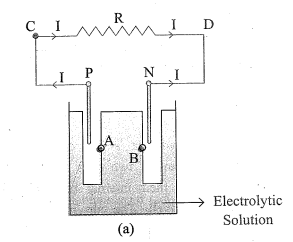
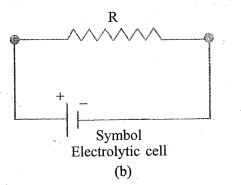
The figure shows the electrolytic cell. Electrolytic cell is used to maintain a steady current in an electric circuit.
As shown in the figure, two electrodes, positive (P) and negative (N) are immersed in an electrolytic solution.
Because of being dipped in the solution, the electrodes exchange charges with the electrolyte.
The potential difference between the positive electrode and the adjacent point A is $V _{+}$and the potential difference between negative electrode to the adjacent point B is $- V _{-}$.
So, the potential difference between P and N is $V_{+}-\left(-V_{-}\right)=V_{+}+V_{-}$
This potential difference is called the electromotive force (emf) of the cell and it is denoted by $\varepsilon$.
$\therefore \varepsilon= V _{+}+ V _{-}>0$
→Definition of emf : The potential difference between two electrodes when no current is flowing through the cell is called the emf of the cell.
As shown in the figure, consider a resistor R connected across the cell and current I flows across R from C to D and current in electrolyte current flows from N to P . clearly, across the electrolyte the same current flows through the electrolyte.
The electrolyte through which a current flows has a finite resistance $r \&$ it is called the internal resistance.
→Case I : $R =\infty$ (infinite)
According to ohm's law
$I =\frac{ V }{ R } \rightarrow I =0$
where V is the potential difference between P and N and it is called terminal voltage (or voltage) of the cell.
The potential difference between P and N , V (terminal voltage or voltage)
$=$ Potential difference between P and A
+ Potential difference between A and B
+ Potential difference between B and N
$\begin{aligned}
V & = V _{+}+ V _{-} \\
\therefore V & =\varepsilon
\end{aligned}$
Thus, emf $\varepsilon$ is the potential difference between the positive and negative electrodes in an open circuit i.e when no current is flowing through the cell.
→Case II : $R =$ Finite
when $R$ is finite, electric current flows through the cell. In that case the potential difference between P and N is
$\begin{aligned}
V & = V _{+}+ V _{-}- I r \\
\therefore \quad V & =\varepsilon- I r
\end{aligned}$
The negative sign in the expression (Ir) for the potential difference between A and B . This is because the current I flows from B to A in the electrolyte.

Need a full question paper?

Generate a complete, print-ready paper with questions like this in minutes — across 16+ boards, with answer keys.
Start Generating Free

Similar questions

An infinite line charge produces a field of 9 x10⁴ N C-1at a distance of 2 cm. Calculate the linear charge density.
Define electric field intensity in current carrying conductor and equipotential surface.
Draw diagrams to depict the behaviour of magnetic field lines near a ‘bar’ of: (i) Copper (ii) Aluminium (iii) Mercury, cooled to a very low temperature (4.2K)
Two moving coil meters, M1 and M2 have the following particulars:
R1 = 10 Ω, N1 = 30,
A1 = 3.6 × 10–3 m2, B1 = 0.25 T
R2 = 14 Ω, N2 = 42,
A2 = 1.8 × 10–3 m2, B2 = 0.50 T
(The spring constants are identical for the two meters).
Determine the ratio of (a) current sensitivity and (b) voltage sensitivity of M2 and M1.
In a chamber, a uniform magnetic field of 6.5 G (1 G = 10–4 T) is maintained. An electron is shot into the field with a speed of 4.8 × 10⁶ m s–1 normal to the field. Explain why the path of the electron is a circle. Determine the radius of the circular orbit.
(e = 1.6 × 10–19 C, me = 9.1×10⁻³¹ kg)
  1. State the condition under which a charged particle moving with velocity v goes undeflected in a magnetic field B.
  2. An electron, after being accelerated through a potential difference of 104 V, enters a uniform magnetic field of 0.04 T, perpendicular to its direction of motion. Calculate the radius of curvature of its trajectory.
A uniform magnetic field of magnitude 0.20T exists in space from east to west. With what speed should a particle of mass 0.010g and with charge 1.0 × 10⁻⁵C be projected from south to north so that it moves with uniform velocity?
Consider Galileo's method of measuring the speed of light using two lanterns. To get an accuracy of about 10%, the time taken by the experimenter in closing or opening the shutter should be about one tenth of the time taken by the light in going from one experimenter to the other. Assume that it takes $\frac{1}{100}$ second for an experimenter to close or open the shutter. How far should the two experimenters be to get a 10% accuracy? What are the difficulties in having this separation?
Fig. shows two positions of a loop PQR in a perpendicular uniform magnetic field. In which position of the coil is there an induced emf?

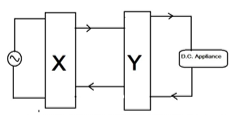
(I) Identify the circuit elements X and Y as shown in the given block diagram and draw the output waveforms of X and Y.

Image

(II) If the centre tapping is shifted towards Diode D1 as shown in the diagram, draw the output waveform of the given circuit.

Image