Question
Explain end-on position and broad side-on position of a bar magnet.

Answer

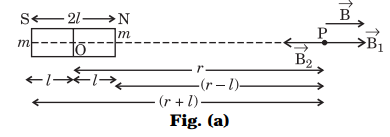
(a) End-on-position of a bar magnet : Let NS be a bar magnet of length $2l$ and 'm' be the pole strength each of its magnetic poles. Suppose P is a point along the axis of the bar magnet at a distance r from the middle point O of the magnet at which the magnetic field intensity due to the bar magnet is to be determined.
This position is called a end on position or longitudinal position. The distance of point P from north pole N is equal to $(r-l)$ and from south pole S is equal to $(r+l)$ [Fig.(a)].
Image
The magnitude of the magnetic field intensity vec $\overrightarrow{ B _1}$ due to north pole N is given by:
$B_1=\frac{\mu_0}{4 \pi}\left[\frac{m}{(r-l)^2}\right]$ ...(1)
Direction of $\overrightarrow{ B _1}$ is away from the magnet along the axis.
The magnitude of the magnetic field intensity $\overrightarrow{ B _2}$ due to south pole S is given by :
$B_2=\frac{\mu_0}{4 \pi}\left[\frac{m}{(r+l)^2}\right]$ ...(2)
Direction of $\overrightarrow{ B _2}$ is towards the magnet along the axis.
From equations (1) and (2) it is obvious that $B _1> B _2$ and $\overrightarrow{ B _1}$ and $\overrightarrow{ B _2}$ both are oppositely directed. Hence the magnitude of the resultant magnetic field $\overrightarrow{ B }$ at P is given by:
$B = B _1- B _2$
$=\frac{\mu_0}{4 \pi}\left[\frac{m}{(r-l)^2}\right]-\frac{\mu_0}{4 \pi}\left[\frac{m}{(r+l)^2}\right]$
$=\frac{\mu_0 m}{4 \pi}\left[\frac{1}{(r-l)^2}-\frac{1}{(r+l)^2}\right]$
or $B =\frac{\mu_0 m}{4 \pi}\left[\frac{(r+l)^2-(r-l)^2}{(r-l)^2(r+l)^2}\right]$
$=\frac{\mu_0 m}{4 \pi}\left[\frac{2 \times 2 r l}{\{(r-l)(r+l)\}^2}\right]$
or $B =\frac{\mu_0}{4 \pi}\left[\frac{2 \times(m \times 2 l) \times r}{\left(r^2-l^2\right)^2}\right]$
But $m \times 2l$ = Magnetic dipole moment of the bar magnet = M
$\therefore \quad B =\frac{\mu_0}{4 \pi}\left[\frac{2 Mr }{\left(r^2-l^2\right)^2}\right]$ ...(3)
If distance r >> $l$ the magnet is called short bar magnet and in this case in equation (3) $l^2$ can be neglected in comparison to r². Hence magnetic field intensity for a short bar magnet is given by :
$B=\frac{\mu_0}{4 \pi}\left[\frac{2 Mr}{\left(r^2\right)^2}\right] \Rightarrow B =\frac{ \mu _0}{ 4 \pi}\left[\frac{ 2 M }{ r ^3}\right] \ldots$(4)
(b) Broad side on position : In this position the point of observation lies on the perpendicular bisector of the bar magnet. This position is called as broad side on position or transverse position.
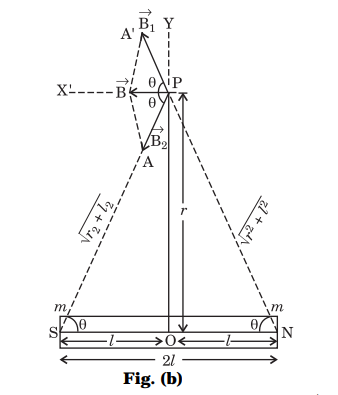
Let in Fig. (b), P be a point in the broad side on position of the bar magnet NS of length $2l$ at a distance $r$ from its centre O and let $m$ be the pole strength of each of its magnetic poles. From Fig. 8.10 it is evident that the distance of the point P from each of the poles N and S is equal and is given as follows :
$NP = SP =\left(r^2+ l ^2\right)^{1 / 2}$
Image
The magnitude of magnetic field intensity $\overrightarrow{ B _1}$ at P due to north pole N is given by :
$B _1=\frac{\mu_0}{4 \pi}\left(\frac{m}{ NP ^2}\right)$
$\Rightarrow \quad B _1=\frac{\mu_0}{4 \pi}\left[\frac{m}{\left(\sqrt{\left.r^2+l^2\right)^2}\right.}\right]$
$\Rightarrow \quad B_1=\frac{\mu_0}{4 \pi}\left[\frac{ m }{\left( r ^2+ l ^2\right)}\right]$... (1)
The direction of $\overrightarrow{ B _1}$ at P is away from the north pole N.
The magnitude of magnetic field intensity $\overrightarrow{ B _2}$ at P due to south pole S is given by :
$B _2=\frac{\mu_0}{4 \pi}\left(\frac{m}{ SP ^2}\right)$
$\Rightarrow \quad B _1=\frac{\mu_0}{4 \pi}\left[\frac{m}{\left(\sqrt{\left(r^2+l^2\right)}\right)^2}\right]$
$\Rightarrow \quad B _2=\frac{\mu_0}{4 \pi}\left[\frac{m}{\left(r^2+l^2\right)}\right]$ ...(2)
The direction of vec $\overrightarrow{ B _2}$ at P is towards the south pole S. From equations (1) and (2) it is obvious that :
$B _1= B _2=\frac{\mu_0}{4 \pi}\left[\frac{m}{\left(r^2+l^2\right)}\right]$
In order to find out the resultant magnetic field at P due to the bar magnet; we have to resolve $\overrightarrow{ B _1}$ and $\overrightarrow{ B _2}$ into two rectangular components: one along equitorial line and the other along axial line.
If $\angle PSO =\theta$, then $\angle SPX ^{\prime}=\theta$ and $\angle ONP =\angle X ^{\prime} PA ^{\prime}$ $=\theta$
The components of vec $\overrightarrow{ B _1}$ and $\overrightarrow{ B _2}$ along equatorial line are $B _1 \sin \theta$ and $B _2 \sin \theta$ respectively. As $B _1= B _2$, hence these components will be equal in magnitude, but are opposite in direction. Therefore these will cancel each other. The components of $\overrightarrow{ B _1}$ and $\overrightarrow{ B _2}$ along axial line will be $B _1 \cos \theta$ and $B _2 \cos \theta$ respectively and these will be added up; because these are in the same direction.
Therefore the resultant magnetic field at P due to bar magnet is given by :
$B = B _1 \cos \theta+ B _2 \cos \theta$
[Along $PX ^{\prime}$ ]
$\Rightarrow \quad B =\frac{\mu_0}{4 \pi}\left[\left(\frac{m}{\left(r^2+l^2\right)}\right) \cos \theta\right]$ $+\frac{\mu_0}{4 \pi}\left[\left(\frac{m}{r^2+l^2}\right) \cos \theta\right]$
or $B =\frac{\mu_0}{4 \pi}\left(\frac{2 m}{r^2+l^2}\right) \cos \theta$
But from right angled triangle $\Delta SOP$, we have
$\cos \theta=\frac{ SO }{ SP }=\frac{l}{\left(r^2+l^2\right)^{1 / 2}}$
$\therefore \quad B =\frac{\mu_0}{4 \pi}\left[\frac{2 m}{\left(r^2+l^2\right)}\right] \times \frac{l}{\left(r^2+l^2\right)^{1 / 2}}$
$\Rightarrow \quad B =\frac{\mu_0}{4 \pi}\left[\frac{2 m l}{\left(r^2+l^2\right)^{3 / 2}}\right]$
$\Rightarrow \quad B =\frac{\mu_0}{4 \pi}\left[\frac{m \times 2 l}{\left(r^2+l^2\right)^{3 / 2}}\right]$
But $m \times 2 l=$ Magnetic dipole moment of the bar magnet = M.
$\therefore \quad B =\frac{\mu_0}{4 \pi}\left[\frac{ M }{\left(r^2+I^2\right)^{3 / 2}}\right]$ ...(3)
Direction of $\overrightarrow{ B }$ is along $PX ^{\prime}$ i.e. from north pole towards south pole parallel to the magnetic axis. Hence its direction is opposite to that of the magnetic dipole moment of the magnet which is directed from south pole towards north pole.
Hence equation in its vector form can be written as follows :
$\vec{B}=-\frac{\mu_0}{4 \pi}\left[\frac{\vec{M}}{\left(r^2+l^2\right)^{3 / 2}}\right]$ ... (4)
For a short bar magnet i.e. a bar magnet of very small length we have $l \ll r$, hence in equations (3) and (4) $l^2$ can be neglected in comparison to $r^2$. Therefore these equations can be written in the following form respectively.
$B=\frac{\mu_0}{4 \pi}\left(\frac{M}{r^3}\right)$ ... (5)
$\overrightarrow{B}=-\frac{\mu_0}{4 \pi}\left(\frac{\overrightarrow{M}}{r^3}\right)$ ... (6)

Need a full question paper?

Generate a complete, print-ready paper with questions like this in minutes — across 16+ boards, with answer keys.
Start Generating Free

Similar questions

Consider a p-n junction diode having the characteristic $\text{i}-\text{i}_0\Big(\text{e}^{\frac{\text{eV}}{\text{kT}}}-1\Big)$ where $\text{i}_0=20\mu\text{A}.$ The diode is operated at T = 300K.
  1. Find the current through the diode when a voltage of 300mV is applied across it in forward bias.
  2. At what voltage does the current double?
Suppose that the radius of cross-section of the wire used in the previous problem is r. Find the increase in the radius of the loop if the magnetic field is switched off. Young's modulus of the material of the wire is Y.
An ammeter is to be constructed that can read currents up to 2.0A. If the coil has resistance of $25\Omega$ and takes 1mA for full-scale deflection, what should be the resistance of the shunt used?
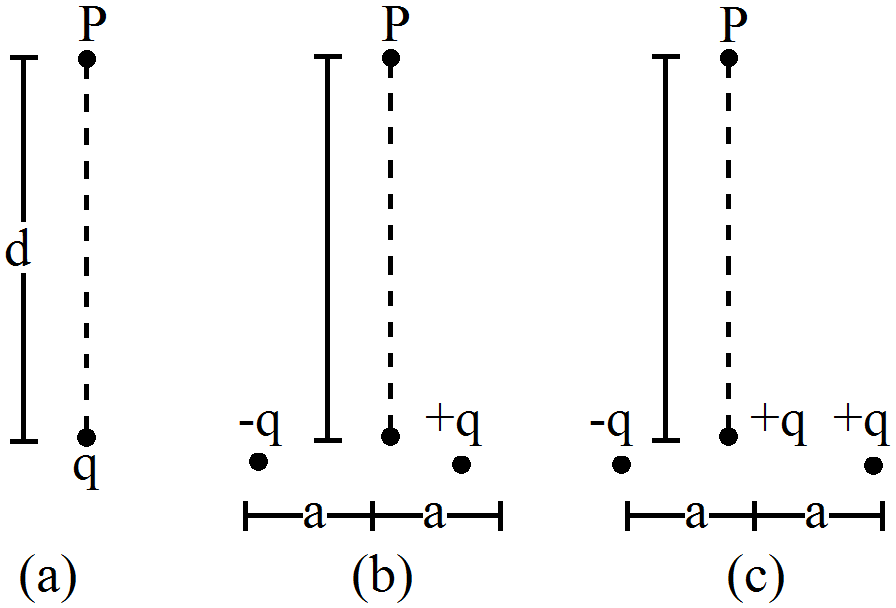
Find the magnitude of the electric field at the point P in the configuration shown in figure for d >> a. Take 2qa = p.

Write the formula for refraction of light at spherical surface (concave or convex). With the help of this formula derive the lens formula : $\frac{1}{f}=(n-1)(\frac{1}{R_{1}}-\frac{1}{R_{2}})$, where symbols used have their usual meanings.
A long, straight wire carrying a current of 30A is placed in an external, uniform magnetic field of 4.0 × 10⁻⁴T parallel to the current. Find the magnitude of the resultant magnetic field at a point 2.0cm away from the wire.
A bucket full of water is placed in a room at 15°C with initial relative humidity 40%. The volume of the room is 50m3.
  1. How much water will evaporate?
  2. lf the room temperature is increased by 5°C, how much more water will evaporate? The saturation vapour pressure of water at 15°C and 20°C are 1.6kPa and 2.4kPa respectively.
Define magnifying power of a telescope. Write its expression.
A small telescope has an objective lens of focal length 150 cm and an eye piece of focal length 5 cm. If this telescope is used to view a 100m high tower 3 km away, find the height of the final image when it is formed 25 cm away from the eye piece.
A hemispherical portion of the surface of a solid glass sphere $(\mu=1.5)$ of radius r is silvered to make the inner side reflecting. An object is placed on the axis of the hemisphere at a distance 3r from the centre of the sphere. The light from the object is refracted at the unsilvered part, then reflected from the silvered part and again refracted at the unsilvered part. Locate the final image formed.
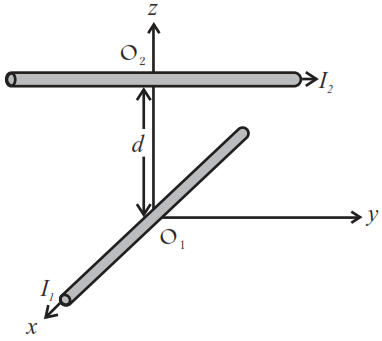
Two long wires carrying current I1 and I2 are arranged as shown in Fig. The one carrying current I1 is along is the x-axis. The other carrying current I2 is along a line parallel to the y-axis given by x = 0 and z = d. Find the force exerted at O2 because of the wire along the x-axis.