Question
Explain equations of Maxwell in detail.

Answer

SELF

Need a full question paper?

Generate a complete, print-ready paper with questions like this in minutes — across 16+ boards, with answer keys.

Start Generating Free

Similar questions

A composite slab is prepared by pasting two plates of thicknesses L1 and L2 and thermal conductivities K1 and K2. The slabs have equal cross-sectional area. Find the equivalent conductivity of the composite slab.
Use Moseley's law with b = 1 to find the frequency of the $\text{K}_\alpha$ X-ray of La(Z = 57) if the frequency of the $\text{K}_\alpha$ X-ray of Cu(Z = 29) is known to be 1.88 × 10¹⁸Hz.
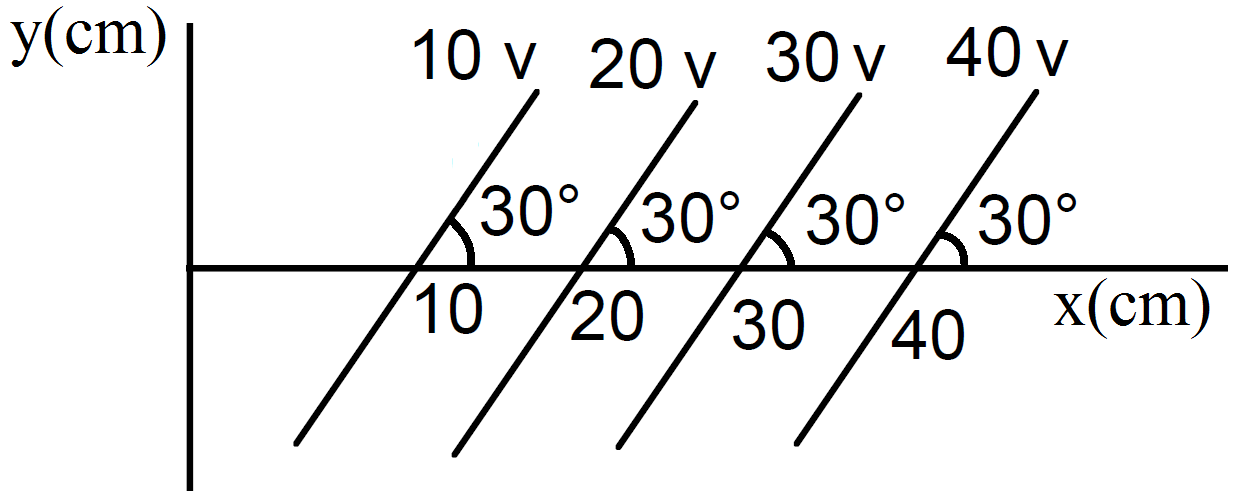
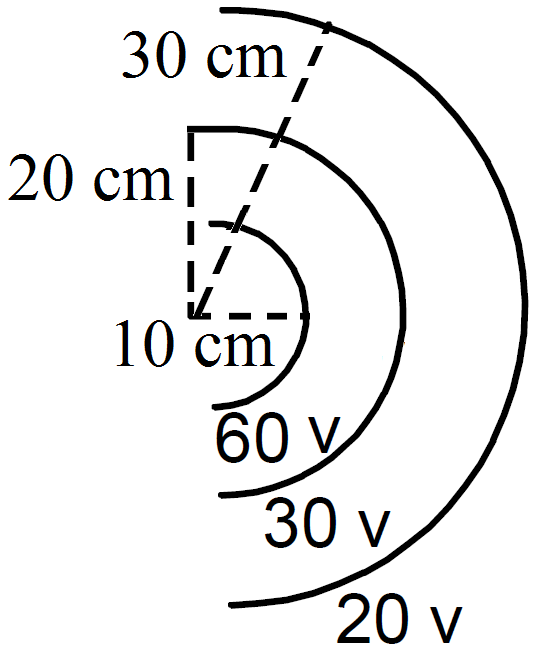
Some equipotential surfaces are shown in figure. What can you say about the magnitude and the direction of the electric field?

Are the nucleons fundamental particles, or do they consist of still smaller parts? One way to find out is to probe a nucleon just as Rutherford probed an atom. What should be the kinetic energy of an electron for it to be able to probe a nucleon? Assume the diameter of a nucleon to be approximately 10-15m.
If the tension in the cable supporting an elevator is equal to the weight of the elevator, the elevator may be:
  1. Going up with increasing speed.
  2. Going down with increasing speed.
  3. Going up with uniform speed.
  4. Going down with uniform speed.
The terminology of different parts of the electromagnetic spectrum is given in the text. Use the formula E = hv (for energy of a quantum of radiation : photon) and obtain the photon energy in units of eV for different parts of the electromagnetic spectrum. In what way are the different scales of photon energies that you obtain related to the sources of electromagnetic radiation?
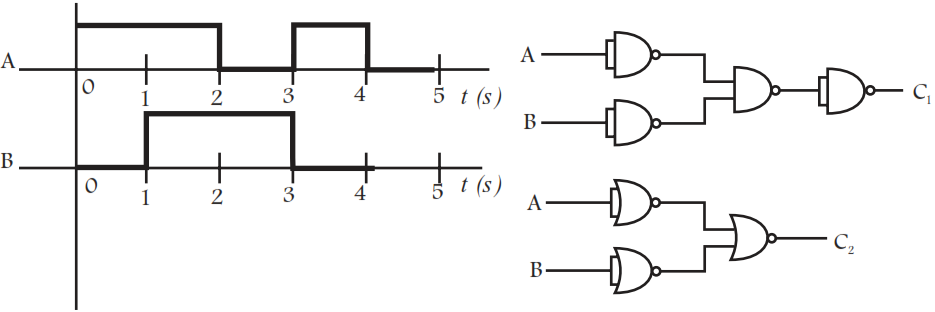
Two car garages have a common gate which needs to open automatically when a car enters either of the garages or cars enter both. Devise a circuit that resembles this situation using diodes for this situation.
A light beam of wavelength 400 run is incident on a metal plate of work function 2.2eV.
  1. A particular electron absorbs a photon and makes two collisions before coming out of the metal. Assuming that 10% of the extra energy is lost to the metal in each collision, find the kinetic energy of this electron as it comes out of the metal.
  2. Under the same assumptions, find the maximum number of collisions the electron can suffer before it becomes unable to come out of the metal.
Consider a thin target (10-2m square, 10-3m thickness) of sodium, which produces a photocurrent of 100μA when a light of intensity 100W/m2 (λ = 660nm) falls on it. Find the probability that a photoelectron is produced when a photons strikes a sodium atom. [Take density of Na = 0.97 kg/m3].