Question
Explain ETS.

Answer

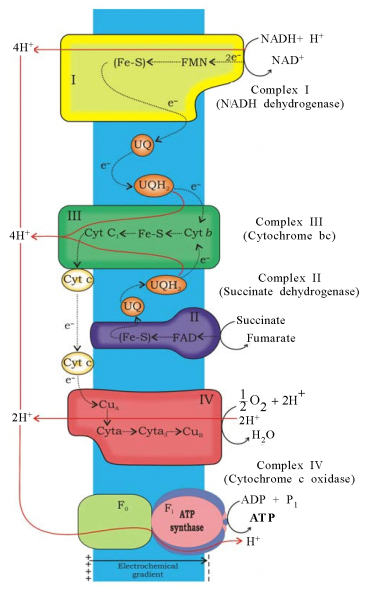
The energy stored in $NADH + H ^{+}$ and $FADH _2$ formed during the respiration process is released and used. This process is accomplished by the electron transport system. When energy is released in it, they are oxidised by the electron transport system and the electron goes to oxygen and water is formed. The metabolic pathway by which electrons pass from one carrier to another is called electron transport system (ETS), which is completed on the inner membrane of mit mitochondria. The electrons produced from NADH during the basal TCA cycle (Krebs' cycle) of mitochondria are oxidised by the enzyme NADH dehydrogenase (Complex I), then the electrons are transferred to ubiquinone present in the inner membrane. Ubiquinone is obtained from reducing equivalents $FADH _2$ (Complex II) that are produced during the oxidation of succinate in the citric acid cycle. The reduced ubiquinone (ubiquinol) gets oxidised by transferring electrons to cytochrome bc₁, cytochrome c (Complex III). Cytochrome c is a small protein stuck to the outer surface of the inner membrane that acts as a mobile carrier to transfer electrons between Complex III and Complex IV. Complex IV is a cytochrome 8 oxidase complex, which contains cytochrome $a, a_3$, and two copper renters.
Image
When electrons pass from one carrier to another in the electron transport chain through Complex I to Complex IV. they combine with ATP synthase (Complex V) to form ATP from ADP and inorganic phosphate. The number of ATP molecules synthesised during this period depends on the electron donor. Oxidation of one molecule of NADH produces three molecules of ATP, while two molecules of ATP are produced from one molecule of FADH, while the oxygen process of respiration takes place only in the presence of $O _2$. The role of $O _2$ is limited in the final stages of the process. Although the presence of $O _2$ is essential because it operates the entire process by releasing hydrogen $H _2$ in the entire system $O _2$ acts as the final hydrogen acceptor. Unlike photophosphorylation, where light energy is used for phosphorylation in the formation of a protein gradient, a similar process in respiration supplies energy through $O _2$ reduction.As a result, the process caused by this is called oxidative phosphorylation.
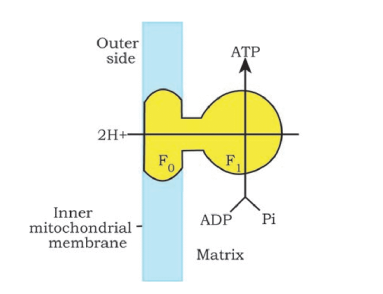
Synthesis of ATP takes place with the help of use of free energy during electron transport mechanism ATP synthase (Complex V). This complex is formed from two major components $F_0$ and $F_1 . F_1$ is the apical peripheral membrane protein complex, where ATP is synthesised from inorganic phosphate and ADP. $2 H ^{+}$ ion intermembrane gap because of electrochemical proton gradient. It moves through F towards the nucleus due to which one ATP is synthesised
Image

Need a full question paper?

Generate a complete, print-ready paper with questions like this in minutes — across 16+ boards, with answer keys.
Start Generating Free