Rajasthan BoardEnglish MediumSTD 11 ScienceBIOLOGYMODEL PAPER 75 Marks
Question
Explain ETS.
✓
Answer
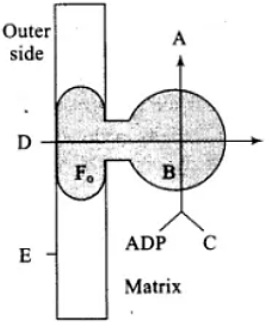
• The metabolic pathway through which the electron passes from one carrier to another, is called the electron transport system {ETS) and it is present in the inner mitochondrial membrane. • The energy stored in NADH +$H ^{+}$ and $FADH _2$ is used as they move through ETS. This is accomplished when they are oxidized through the electron transport system and the electrons are passed on to $O _2$. resulting in the formation of $H _2 O$. • Electrons from NADH produced in the mitochondrial matrix during citric acid cycle are oxidised by an NADH dehydrogenase (complex I), and electrons are then transferred to ubiquinone located within the inner membrane. Ubiquinone also receives reducing equivalents via $FADH _2$ (complex II) that is generated during oxidation of succinate in the citric acid cycle. • The reduced ubiquinone is then oxidised with the transfer of electrons to cytochrome c via cytochrome bc1 complex (complex III). • Cytochrome c acts as a mobile carrier for transfer of electrons between complex III and IV. Complex IV refers to cytochrome c oxidase complex containing cytochromes a and a³, and two copper centres. • When the electrons pass from one carrier to another via complex I to IV in the electron transport chain, they are coupled to ATP synthase (complex V) for the production of ATP from ADP and inorganic phosphate. The number of ATP molecules synthesized depends on the nature of the electron donor. • Oxidation of one molecule of NADH gives rise to 3 molecules of ATP, while that of one molecule of $FADH _2$ produces 2 molecules of ATP. The presence of oxygen is vital, since it drives the whole process by removing hydrogen from the system. Oxygen acts as the final hydrogen acceptor. • Unlike photophosphorylation where it is the light energy that is utilized for the production of proton gradient required for phosphorylation, in respiration it is the energy of oxidation-reduction utilized for the same process. It is for this reason that the process is called oxidative phosphorylation. • The energy released during the electron transport system is utilized in synthesizing ATP with the help of ATP synthase (complex V). This complex consists of two major components, $F _1$ and $F _0$. The $F _1$ headpiece is a peripheral membrane protein complex and contains the site for synthesis of ATP from ADP and inorganic phosphate. $F _0$ is an integral membrane protein complex that forms the channel through which protons cross the inner membrane. The passage of protons through the channel is coupled to the catalytic site of the F, component for the production of ATP. For each ATP produced, $2 H ^{+}$ passes through $F _0$ from the inter membrane space to the matrix down the electrochemical proton gradient.
Need a full question paper?
Generate a complete, print-ready paper with questions like this in minutes — across 16+ boards, with answer keys.