Question
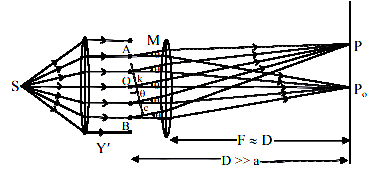
Explain experimental setup for Fraunhofer diffraction with neat diagram.

Answer

  1. Set up for Fraunhofer diffraction has a monochromatic source of light S at the focus of a converging lens. Ignoring aberrations, the emerging beam will consist of plane parallel rays resulting in-plane wavefronts.
  2. These are incidents on the diffracting element such as a slit, a circular aperture, a double slit, a grating, etc.
  3. In the case of a circular aperture, S is a point source and the lenses are bi-convex. For linear elements like slits, grating, etc., the source is linear and the lenses are cylindrical in shape so that the focussed image is also linear.

    Set up for Fraunhofer diffraction
  4. An emerging beam is an incident on another converging lens that focuses the beam on a screen.

Need a full question paper?

Generate a complete, print-ready paper with questions like this in minutes — across 16+ boards, with answer keys.
Start Generating Free

Similar questions

At what distance from the mean position is the kinetic energy of a particle performing S.H.M. of amplitude 8 cm, three times its potential energy?
In a circus, a motor-cyclist having mass of \(50 kg\) moves in a spherical cage of radius \(3 m\). Calculate the last velocity with which he must pass the highest point without losing contact. Also calculate his angular speed at the highest point.
State the characteristics of pressure due to a liquid at rest at a point within it.
Define the current gain $\alpha_{D C}$ and $\beta_{D C}$ for a transistor. Obtain the relation between them
$32$ tuning forks are arranged in descending order of frequencies. If any two consecutive tuning forks are sounded together, the number of beats heard is eight per second. The frequency of the first tuning fork is octave of the last fork. Calculate the frequency of the first, last and the $21$ st fork.
Write ideal gas equation for a mass of 7 g of nitrogen gas.
The primary of a transformer has $40$ turns and works on $100\ V$ and $100\ W.$ Find a number of turns in the secondary to step up the voltage to $400\ V.$ Also calculate the current in the secondary and primary.
In a common-base connection, the emitter current is $6.28\ mA$ and collector current is $6.20\ mA.$ Determine the common base $DC$ current gain.
Two coherent sources, whose intensity ratio is $81: 1$, produce interference fringes. Calculate the ratio of the intensities of maxima and minima in the fringe system.
What is Transformer?