Question
Explain ferromagnetism and ferromagnetic substances.

Answer

Ferromagnetic substances are those which get strongly magnetised when placed in an external magnetic field.
The individual atoms in a ferromagnetic material possess a dipole moment as in a paramagnetic material.
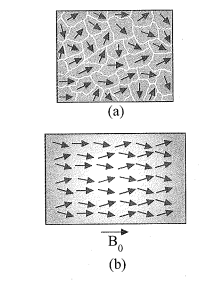
The neighbouring atoms are bound by strong attraction force. This bonding however, is limited to a small region. The atoms (molecules) in such small regions (small microscopic volumes) interact in such a way that their dipole moments are aligned in a common direction.
Such regions (macroscopic volumes) are called domain(s).
Each domain has some net magnetisation. But the magnetisation varies randomly from domain to domain, and there is no bulk magnetisation.
Typical domain size is 1 mm and the domain contains about $10^{11}$ atoms.

Image
When external magnetic field $\left(\overrightarrow{ B _0}\right)$ is applied, the domains orient themselves in the direction of $\vec{B}_0$.
Simultaneously the domain oriented in the direction of $\overrightarrow{B_0}$ grow in size. As shown in fig. (b) all domains merge gradually and make a larger/'giant' domain.
Thus, in a ferromagnetic material, field lines are highly concentrated.
When such materials are placed in non-uniform magnetic field, they are attracted towards strong magnetic field.
Examples : Some Ferromagnetic materials such as iron, cobalt, nickel, gadolinium etc. have relative magnetic permeability $>1000$.

Need a full question paper?

Generate a complete, print-ready paper with questions like this in minutes — across 16+ boards, with answer keys.
Start Generating Free

Similar questions

A rectangular coil of 100 turns has length 5cm and width 4cm. It is placed with its plane parallel to a uniform magnetic field and a current of 2A is sent through the coil. Find the magnitude of the magnetic field B if the torque acting on the coil is 0.2N m-1.
According to Maxwell's theory of electrodynamics, an electron going in a circle should emit radiation of frequency equal to its frequency of revolution. What should be the wavelength of the radiation emitted by a hydrogen atom in ground state if this rule is followed?
What was the difficulty with the wave theory ? How was this difficulty explained using Maxwell's Electro-magnetic wave theory ?
Is the vector sum of the unit vectors $\vec{\text{i}}$ and $\vec{\text{j}}$ unit vector? If no, can you multiply this sum by a scalar number to get a unit vector?
The apparent weight of an object increases in an elevator while accelerating upward. A moongphaliwala sells his moongphali using a beam balance in an elevator. Will he gain more if the elevator is accelerating up?
Name the semiconductor device that can be used to regulate an unregulated dc power supply. With the help of I-V characteristics of this device, explain its working principle.
Light possesses wave nature. It is strongly proved from which two experiments ?
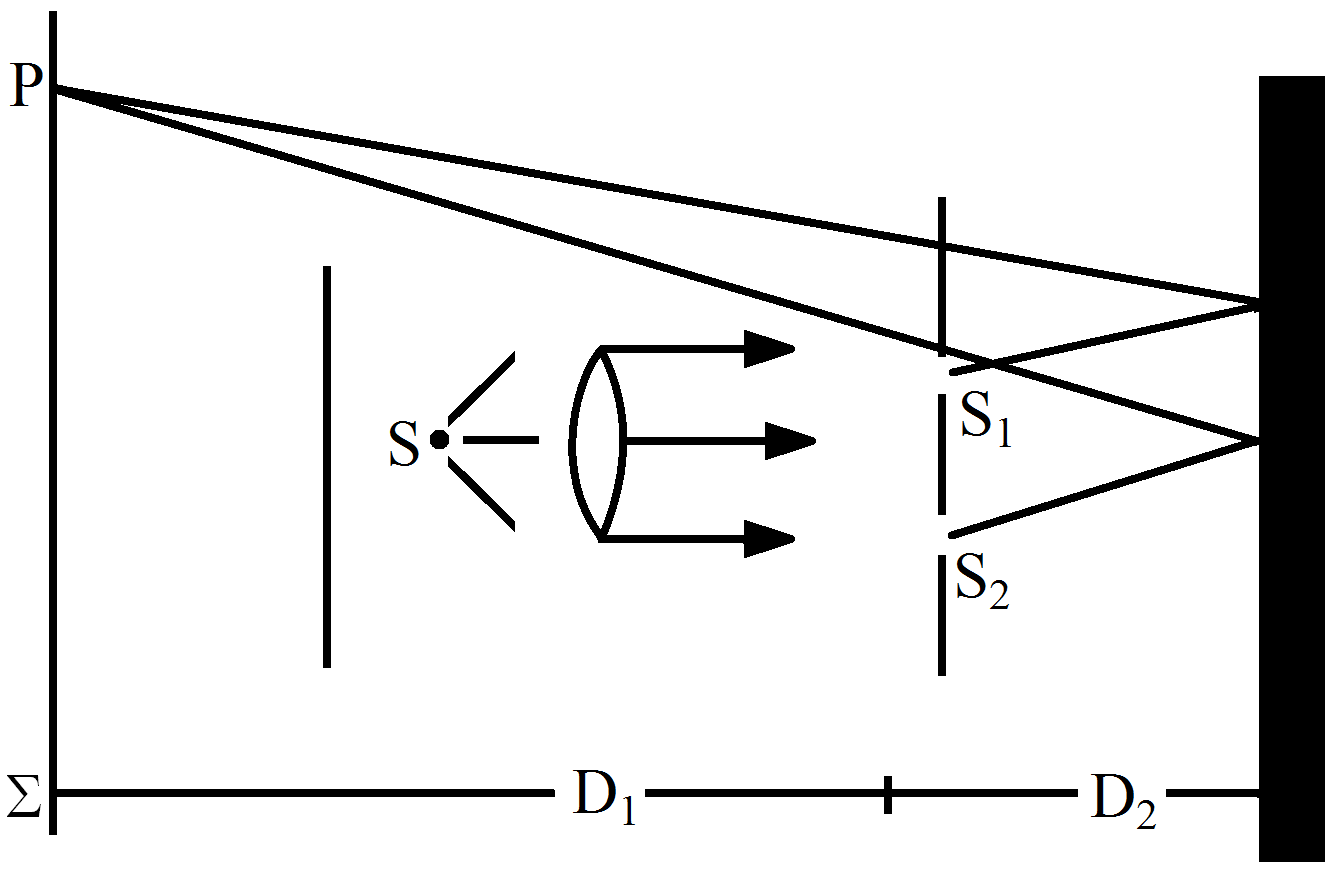
A double slit S1 - S2 is illuminated by a coherent light of wavelength $\lambda$. The slits are separated by a distance d. A plane mirror is placed in front of the double slit at a distance D1 from it and a screen $\sum$ is placed behind the double slit at a distance D2 from it (figure 17-E2). The screen E receives only the light reflected by the mirror. Find the fringe-width of the interference pattern on the screen.

A smooth block loosely fits in a circular tube placed on a horizontal surface. The block moves in a uniform circular motion along the tube (figure). Which wall (inner or outer) will exert a nonzero normal contact force on the block?

Two point charges of $+10 \mu C$ and $-10 \mu C$ are kept at a distance of 40 cm from each other in air.(a) Calculate the electrical potential energy of the system. Assume that the electric potential energy at infinity is zero.(b) Draw the equipotential surface for the system.(c) How much work will have to be done to separateboth the charges of the system to infinity?