Question
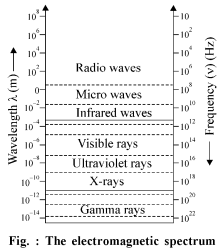
Explain frequency and wavelength of electromagnetic spectrum.

Answer

Electromagnetic spectrum : Due to same characteristics of radio waves, micro waves, infrared, visible light, ultraviolet rays, X-rays, gamma rays etc. as of electromagnetic waves, these all are electromagnetic waves. The only difference is their wavelengths are different. It is clear that extension of wavelengths of electromagnetic waves is very wide, so these waves can be kept in a sequence depending on wavelength and it is known as electromagnetic spectrum.

Image

Need a full question paper?

Generate a complete, print-ready paper with questions like this in minutes — across 16+ boards, with answer keys.
Start Generating Free

Similar questions

A uniformly moving train passes by a long platform. Consider the events' engine crossing the beginning of the platform' and 'engine crossing the end of the platform'. Which frame (train frame or the platform frame) is the proper frame for the pair of events?
Find the radius and energy of a $He^+$ ion in the states $(a) n = 1, (b) n = 4$ and $(c) n = 10.$
A candle flame 1.6cm high is imaged in a ball bearing of diameter 0.4cm. If the ball bearing is 20cm away from the flame, find the location and the height of the image.
The ground state energy of hydrogen atom is –13.6 eV.
  1. What is the kinetic energy of an electron in the $2^{nd}$ excited state?
  2. If the electron jumps to the ground state from the $2^{nd}$ excited state, calculate the wavelength of the spectral line emitted.
If mercury and glass had equal coefficient of volume expansion, could we make a mercury thermometer in a glass tube?
A magnetic flux of $8 \times 10^{-4}$ weber is linked with each turn of a 200-turn coil when there is an electric current of 4A in it. Calculate the self-inductance of the coil.
What is the de Broglie wavelength associated with $(a)$ an electron moving with a speed of $5.4 \times 10^6 m / s$, and $(b)$ a ball of mass $150 g$ travelling at $30.0 m / s$ ?
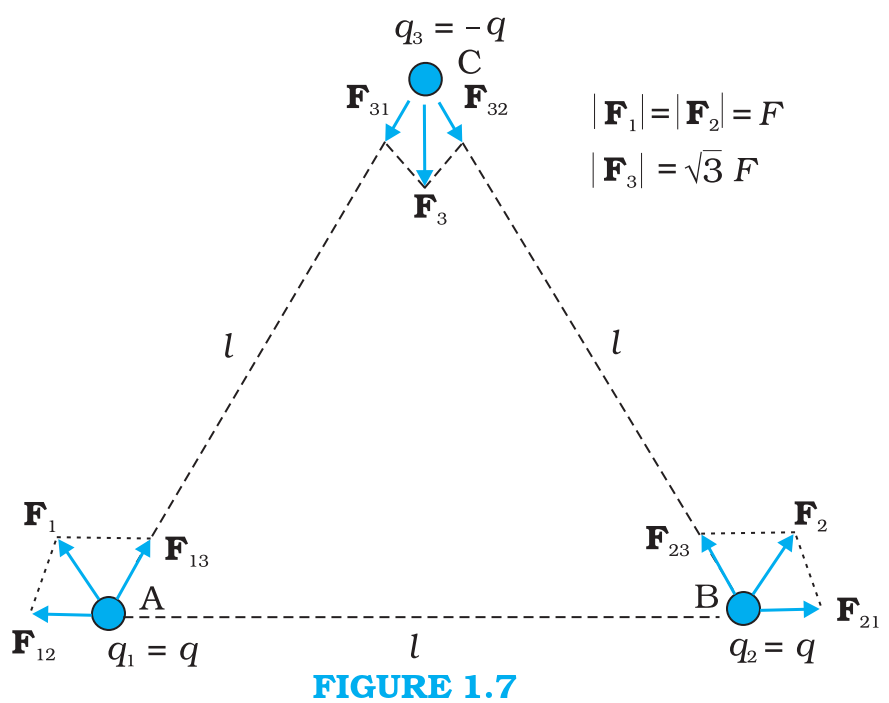
Consider the charges q, q, and –q placed at the vertices of an equilateral triangle, as shown in Fig. 1.7. What is the force on each charge?
Image
  1. A giant refracting telescope at an observatory has an objective lens of focal length 15 m. If an eyepiece of focal length 1.0 cm is used, what is the angular magnification of the telescope?
  2. If this telescope is used to view the moon, what is the diameter of the image of the moon formed by the objective lens? The diameter of the moon is $3.48 \times 10^6m$, and the radius of lunar orbit is $3.8 \times 10^8m.$
  1. Write the expression for the speed of light in a material medium of relative permittivity $\varepsilon_\text{r}$ and relative magnetic permeability $\mu_\text{r}.$
  2. Write the wavelength range and name of the electromagnetic waves which are used in:
  1. Radar systems for aircraft navigation,
  2. Earth satellites to observe the growth of the crops.