Question
Explain Gause's Competitive Exclusion Principle with the help of a suitable example.

Answer

  1. Gause's Competitive Exclusion Principle states that two closely related species competing for the same resources cannot co-exist indefinitely and the competitively inferior one will be eliminated eventually.
  2. This is true not only when the resources are limiting but also when resources are abundant.
  3. For example, the Abingdon tortoise in Galapagos Islands became extinct within a decade after the goats were introduced into the Island.
  4. It is probably due to the greater browsing efficiency of the goat or the feeding efficiency of one species (tortoise) is reduced by the interfering presence of the other species (goat).

Need a full question paper?

Generate a complete, print-ready paper with questions like this in minutes — across 16+ boards, with answer keys.

Start Generating Free

Similar questions

Name the cells that nourish the germ cells in the testes. Where are these cells located in the testes?
What is inbreeding depression and how is it caused in organisms? Write any two advantages of inbreeding.
Discuss briefly the following:
  1. Greenhouse gases.
  2. Catalytic converter.
  3. Ultraviolet B.
The steps in a programme are:
  • Collection of germplasm.
  • Cross breeding the selected parents.
  • Selecting superior recombinant progeny-Testing, releasing and marketing new cultivars.
  1. What is this programme related to?
  2. Name two special qualities as basis of selection of the progeny.
  3. What is the popular term given to this outcome? Also name the Indian scientist
  4. who is credited with chalking out this programme?
Water pollinated (hydrophilous) plants.
Haemophilia and sickle-cell anaemia are blood related Mendelian disorders. Yet, they differ in their pattern of inheritance. Explain the difference.
State any three methods by which animals cope with the temporary unfavourable conditions in their habitat when they cannot migrate.
Outline how restriction enzymes are used for removing sections of DNA from a chromosome.
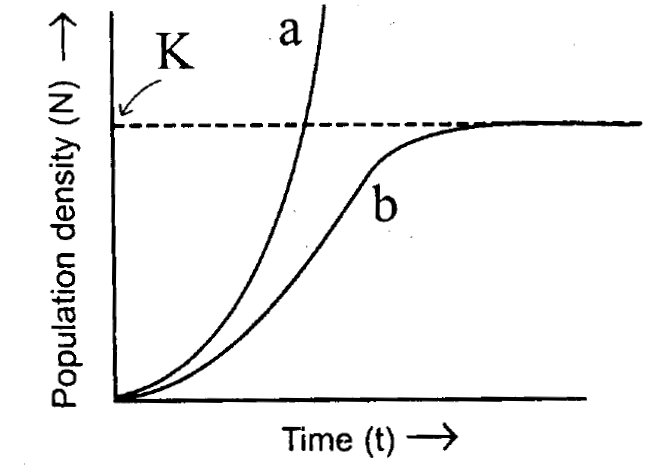
Study the population growth curves in the graph given below and answer the questions which follow:
  1. Identify the growth curves ‘a’ and ‘b'.
  2. Which one of them is considered a more realistic one and why?
  3. If dN/dt=rN(K-N/K) is the equation of the logistic growth curve, what does K stand for?
  4. What is symbolised by N?
How does the sperm penetrate through the zona pellucida in human ovum?