Question
Explain Gauss's law for magnetism

Answer

Image
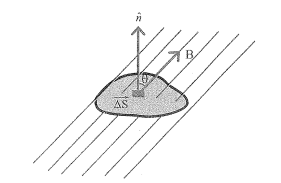
→As shown in the Fig., consider a surface ' S ' in a uniform magnetic field.
→To calculate the magnetic flux associated with the surface, imagine the surface ' S ' to be divided into many small area elements.
→Consider a small vector area element $\overrightarrow{\Delta S}$ from all such area elements.
→Magnetic flux passing through this area element.
$\Delta \phi_{ B }=\overrightarrow{ B } \cdot \overrightarrow{\Delta S }$
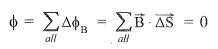
→Total magnetic flux associated with the surface S ,
Image
[That is because, for any enclosed surface, number of magnetic field lines leaving the surface is same as the number of field lines entering the surface. This means that the total positive flux is same as total negative fiux and hence the net magnetic flux is zero.]
In the eq. (1) 'all' stands for 'all area elements $\overrightarrow{\Delta S}$ '. This can be compared with the Gauss's law of electrostatics.
$\sum \overrightarrow{ E } \cdot \overrightarrow{\Delta S }=\frac{q}{\varepsilon_0}$
→From eq. (1), the Gauss's law for magnetism can be written as follows :
"The net magnetic flux through any closed surface is zero."
→Magnetic flux is a scalar quantity. SI unit of magnetic flux is :
$W b \text { (weber) }= T m^2$

Need a full question paper?

Generate a complete, print-ready paper with questions like this in minutes — across 16+ boards, with answer keys.
Start Generating Free

Similar questions

Write and explain Ampere's circuital law.
Find an expression for intensity of transmitted light when a polaroid sheet is rotated between two crossed polaroids. In which position of the polaroid sheet will the transmitted intensity be maximum?
A bulb is made using two filaments. A switch selects whether the filaments are used individually or in parallel. When used with a 15V battery, the bulb can be operated at 5W, 10W or 15W. What should be the resistances of the filaments?
The charge on a proton is $+1.6 \times 10^{-19} \mathrm{C}$ and that on an electron is $-1.6 \times 10^{-19} \mathrm{C}$. Does it mean that the electron has a charge $3.2 \times 10^{-19} \mathrm{C}$ less than the charge of a proton?
A particle moves from a point $\vec{\text{r}}_1=(2\text{m})\vec{\text{i}}+(3\text{m})\vec{\text{j}}$ to another point $\vec{\text{r}}_2=(3\text{m})\vec{\text{i}}+(2\text{m})\vec{\text{j}}$ during which a certain force $\vec{\text{F}}=(5\text{N})\vec{\text{i}}+(5\text{N})\vec{\text{j}}$ acts on it. Find the work done by the force on the particle during the displacement.
An electric dipole is placed inside a closed surface, whose dipole moment is $20 \times 10^{-6}$ coulomb$-$meter. What will be the electric flux emerging out of this surface?
Explain Ohm's law.
Name the nucleus for which the binding energy per nucleon is maximum.
In order to have a current in a long wire, it should be connected to a battery or some such device. Can we obtain the magnetic due to a straight, long wire by using Ampere's law without mentioning this other part of the circuit?
When rubber sheets are used in a shock absorber, what happens to the energy of vibration?