Question
Explain Gauss's law for magnetism

Answer

Image
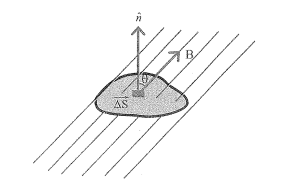
→As shown in the Fig., consider a surface ' S ' in a uniform magnetic field.
→To calculate the magnetic flux associated with the surface, imagine the surface ' S ' to be divided into many small area elements.
→Consider a small vector area element $\overrightarrow{\Delta S}$ from all such area elements.
→Magnetic flux passing through this area element.
$\Delta \phi_{ B }=\overrightarrow{ B } \cdot \overrightarrow{\Delta S }$
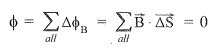
→Total magnetic flux associated with the surface S ,
Image
[That is because, for any enclosed surface, number of magnetic field lines leaving the surface is same as the number of field lines entering the surface. This means that the total positive flux is same as total negative fiux and hence the net magnetic flux is zero.]
In the eq. (1) 'all' stands for 'all area elements $\overrightarrow{\Delta S}$ '. This can be compared with the Gauss's law of electrostatics.
$\sum \overrightarrow{ E } \cdot \overrightarrow{\Delta S }=\frac{q}{\varepsilon_0}$
→From eq. (1), the Gauss's law for magnetism can be written as follows :
"The net magnetic flux through any closed surface is zero."
→Magnetic flux is a scalar quantity. SI unit of magnetic flux is :
$W b \text { (weber) }= T m^2$

Need a full question paper?

Generate a complete, print-ready paper with questions like this in minutes — across 16+ boards, with answer keys.
Start Generating Free

Similar questions

Find the value of X in the given figure.
Image
Arrange the following electromagnetic waves in the order of their increasing wavelength :
a. $\gamma$-rays
b. Microwaves
c. X-rays
d. Radio waves
How are infra-red waves produced? What role does infra-red radiation play in
i. maintaining the Earth's warmth and
ii. physical therapy?
Do two positively charged balls attract each other?
A proton and an a-particle have the same de-Broglie wavelength. Determine the ratio of (i) Their accelerating potentials and (ii) Their speeds.
Use Kirchhoff ’s rules to determine the potential difference between the points A and D when no current flows in the arm BE of the electric network shown in the figure.

A bulb is made using two filaments. A switch selects whether the filaments are used individually or in parallel. When used with a 15V battery, the bulb can be operated at 5W, 10W or 15W. What should be the resistances of the filaments?
Calculate the energy in fusion reaction:
$^{2}_{1}\text{H} + ^{2}_{1}\text{H}\rightarrow^{3}_{2}\text{H}+ \text{n}, \text{where BE}\text{ of} ^{ 2}_{1}\text{H} = 2.23 \text{MeV} \text{and} \text{of} ^{3}_{2}\text{He} = 7.73 \text{MeV}.$
Prove $n_e \cdot n_h=n_i^2$ for $n$-type and $p$-type semiconductors where,
$n_e$ - number density of electrons
$n_h$ - number density of holes
$n_i$ - number density of intrinsic charge carriers
 An alternating voltage of frequency f is applied across a series LCR circuit. Let fr be the resonance frequency for the circuit. Will the current in the circuit lag, lead or remain in phase with the applied voltage when (i) f > f r, (ii) f < fr? Explain your answer in each case. 
Complete the following decay schemes.
  1. $\text{ }^{226}_{88}\text{Ra}\rightarrow\alpha+$
  2. $\text{ }^{19}_8\text{O}\rightarrow\text{ }^{19}_9\text{F}+$
  3. $\text{ }^{25}_{13}\text{Al}\rightarrow\text{ }^{25}_{12}\text{Mg}+$