In most systems, the initial growth is slow (lag phase), and it increases rapidly thereafter-at an exponential rate (log or exponential phase). Here, both the progeny cells following mitotic cell division retain the ability to divide and continue to do so. However, with limited nutrient supply, the growth slows down leading to a stationary phase. If we plot the parameter of growth against time, we get a typical sigmoid or S-curve. A sigmoid curve is a characteristic of living organism growing in a natural environment. It is typical for all cells, tissues and organs of a plant.
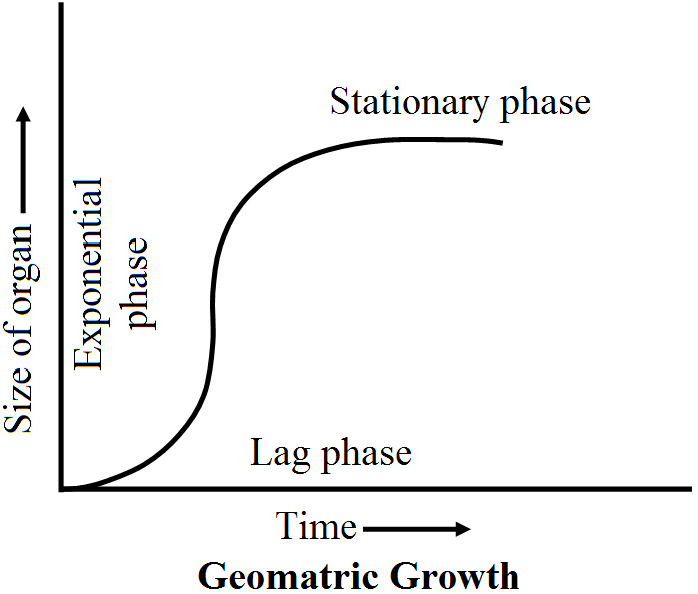
The exponential growth can be expressed as:
W
1 = W
0 ert
W
1 = final size (weight, height, number etc.)
W
0 = initial size at the beginning of the period
r = growth rate
t = time of growth
e = base of natural logarithms
Here, r is the relative growth rate and is also the measure of the ability of the plant to produce new plant material, referred to as efficiency index. Hence, the final size of W
1 depends on the initial size, W
0.