Question
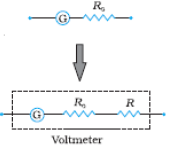
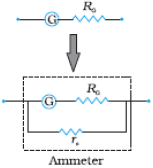
  1. Explain, giving reasons, the basic difference in converting a galvanometer into (i) a voltmeter and (ii) an ammeter.
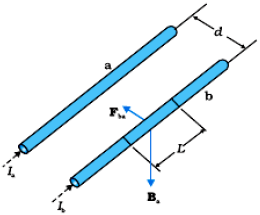
  2. Two long straight parallel conductors carrying steady currents I1 and I2 are separated by a distance 'd'. Explain briefly, with the help of a suitable diagram, how the magnetic field due to one conductor acts on the other. Hence deduce the expression for the force acting between the two conductors. Mention the nature of this force.

Answer

  1. A galvanometer can be converted into a voltmeter by connecting a high resistance in series with its coil.
  2. A galvanometer can be converted into an ammeter by connecting a low resistance in parallel to its coil.

Alternate Answer
The magnetic field, due to wire – 1, at any point on the wire – 2, is directed normal to the direction of current flowin wire – 2.

Expression for force

B21 =Magnetic field atwire – 2, due to a current I1 in

wire $ - 1 = \frac{\mu_{o}\text{I}_{1}}{2\pi\text{r}}$

Force upon conductor carrying current due to magnetic field

$\overrightarrow{\text{F}} = \text{I}(\overrightarrow{\ell}\times\overrightarrow{\text{B}})$

$\therefore\text{ Force, F}_{21}\text{ on a length l of wire} – 2 = \text{I}_{2} . l.\frac{\mu_{o}\text{I}_{1}}{2\pi\text{r}}$

$ =\frac{\mu_{o}\text{I}_{1}\text{I}_{2}}{2\pi\text{r}}l$

$\text{Similarly,} = \text{F}_{12} = \frac{\mu_{0}\text{I}_{1}\text{I}_{2}}{2\pi\text{r}}l$

Nature
The force is repulsive for currents in opposite direction and attractive when currents flow in the same direction.

Need a full question paper?

Generate a complete, print-ready paper with questions like this in minutes — across 16+ boards, with answer keys.

Start Generating Free

Similar questions

An X-ray tube operates at 40kV. Suppose the electron converts 70% of its energy into a photon at each collision. Find the lowest there wavelengths emitted from the tube. Neglect the energy imparted to the atom with which the electron collides.
In a semiconductor, electrons and holes move in opposite directions to each other. How? Explain with figure.
A charge of $1\mu\text{C}$ is given to one plate of a parallel-plate capacitor of capacitance $0.1\mu\text{F}$ and a charge of $2\mu\text{C}$ is given to the other plate. Find the potential difference developed between the plates.
An LC circuit contains a 20mH inductor and a 50μF capacitor with an initial charge of 10mC. The resistance of the circuit is negligible.
Let the instant the circuit is closed be t = 0.
  1. What is the total energy stored initially? Is it conserved during LC oscillations?
  2. What is the natural frequency of the circuit?
  3. At what time is the energy stored
  1. completely electrical (i.e., stored in the capacitor)?
  2. completely magnetic (i.e., stored in the inductor)?
  1. At what times is the total energy shared equally between the inductor and the capacitor?
  2. If a resistor is inserted in the circuit, how much energy is eventually dissipated as heat?
The radius of a gold nucleus (Z = 79) is about 7.0 × 10⁻¹⁵m. Assume that the positive charge is distributed uniformly throughout the nuclear volume. Find the strength of the electric field at:
  1. The surface of the nucleus.
  2. At the middle point of a radius. Remembering that gold is a conductor, is it justified to assume that the positive charge is uniformly distributed over the entire volume of the nucleus and does not come to the outer surface?
A constant current exists in an inductor-coil connected to a battery. The coil is short-circuited and the battery is removed. Show that the charge flown through the coil after the short-circuiting is the same as that which flows in one time constant before the short-circuiting.
What is a transformer? It is of how many types? Explain the principle, construction and working of any transformer.
When the sun is directly overhead, the surface of the earth receives 1.4 × 10³ W m-2 of sunlight. Assume that the light is monochromatic with average wavelength 500nm and that no light is absorbed in between the sun and the earth's surface. The distance between the sun and the earth is 1.5 × 10¹¹m.
  1. Calculate the number of photons falling per second on each square metre of earth's surface directly below the sun.
  2. How many photons are there in each cubic metre near the earth's surface at any instant?
  3. How many photons does the sun emit per second?
A beam of white light is incident normally on a plane surface absorbing 70% of the light and reflecting the rest. If the incident beam carries 10W of power, find the force exerted by it on the surface.
A tightly-wound, long solenoid is kept with its axis parallel to a large metal sheet carrying a surface current. The surface current through a width dl of the sheet is Kdl and the number of turns per unit length of the solenoid is n. The magnetic field near the centre of the solenoid is found to be zero.
  1. Find the current in the solenoid.
  2. If the solenoid is rotated to make its axis perpendicular to the metal sheet, what would be the magnitude of the magnetic field near its centre ?