Question
Explain ground state and ionisation energy of hydrogen atom.
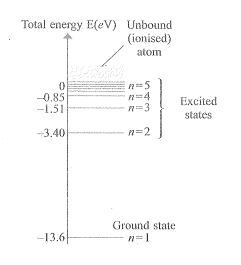
Answer

The energy of an atom is the least when its electron is revolving in an orbit closest to the nucleus i.e., for $n=1$.
As the value of $n$ increases, the energy of the electron also increases.
The lowest state of the atom is called the ground state, is that of lowest energy, with the electron revolving in the orbit of smallest radius, the Bohr radius $\left(a_0\right)$.

Image
The energy of this state
$\begin{array}{l} 
E _n=-\frac{13.6}{n^2} e V \\
n=1 \\
E _1=-13.6 eV
\end{array}$
Therefore, the minimum energy required to free the electron from the ground state of the hydrogen atom is 13.6 eV . It is called the ionisation energy of a the hydrogen atom.

Need a full question paper?

Generate a complete, print-ready paper with questions like this in minutes — across 16+ boards, with answer keys.

Start Generating Free

Similar questions

Show that if the room temperature changes by a small amount from T to $\text{T}+\triangle\text{T},$ the fundamental frequency of an organ pipe changes from v to $\text{v}+\triangle\text{v},$ where-

$\frac{\triangle\text{v}}{\text{v}}=\frac{1}{2}\frac{\triangle\text{T}}{\text{T}}.$

The circuit arrangement given below shows that when an a.c. passes through the coil A, the current starts flowing in the coil B.
  1. State the underlying principle involved.
  2. Mention two factors on which the current produced in the coil B depends.
Suppose, we think of fission of a $^{56}_{26}\text{Fe}$ nucleus into two equal fragments, $^{28}_{13}\text{Al}.$ Is the fission energetically possible? Argue by working out Q of the process. Given $\text{m}(^{56}_{26}\text{Fe})=55.93494\text{ u and m }(^{28}_{13}\text{Al})=27.98191\text{ u}.$
A platinum surface having work function 5.63 eV is illuminated by a monochromatic source of $1.6 \times 10^{15} Hz$ Hz. What will be the minimum wavelength associated with the ejected electron.
An electron is placed in an electric field. If a proton is placed in its place, what will be the relation between the forces experienced by them?
A charge Q is placed at the centre of a cube. Find the flux of the electric field through the six surfaces of the cube.
A small town with a demand of 800kW of electric power at 220V is situated 15km away from an electric plant generating power at 440V. The resistance of the two wire line carrying power is 0.5Ω per km. The town gets power from the line through a 4000-220V step-down transformer at a sub-station in the town.
  1. Estimate the line power loss in the form of heat.
  2. How much power must the plant supply, assuming there is negligible power loss due to leakage?
  3. Characterise the step up transformer at the plant.
State Bohr’s quantisation condition of angular momentum. Calculate the shortest wavelength of the Bracket series and state to which part of the electromagnetic spectrum does it belong.
Distinguish between diamagnetic and ferromagnetic materials in terms of
i. susceptibility and
ii. their behaviour in a non-uniform magnetic field
The objective of a telescope is large and the eyepiece is small, whereas the objective of a microscope is small and the eyepiece is large. If a telescope is turned upside down, can it be used like a microscope? Can a microscope be used like a telescope in the same way?