Question
Explain ground wave and sky wave.

Answer

Ground waves : These waves are radio waves of smaller frequencies which travel from one point on the surface of the earth to the other point on the surface of earth travelling along the surface of earth. With their help, the radio programs which are broadcasted in a limited area are broadcasted. These waves are known as ground waves.
Sky waves: Radio waves travel in straight lines and hence they are not able to travel long distances due spherical shape of the earth. If they are of smaller frequencies, they travel along the surface of the earth but if frequency is more, they are not able to travel to a large distance. Waves of higher frequency strike with the lower part of the ionosphere and reach larger distance on the earth. Since these waves come back from the sky and reach any place on earth, are known as sky waves.
Need a full question paper?

Generate a complete, print-ready paper with questions like this in minutes — across 16+ boards, with answer keys.

Start Generating Free

Similar questions

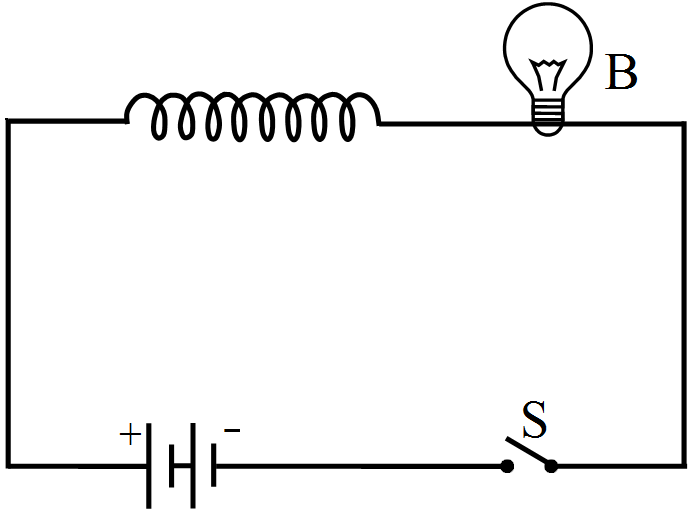
Figure shows a light bulb (B) and iron cored inductor connected to a dc battery through a switch (S).

  1. What will one observe when switch (S) is closed?
  2. How will the glow of the bulb change when the battery is replaced by an ac source of rms voltage equal to the voltage of dc battery? Justify your answer in each case.
How much energy is released in the following reaction?
$\text{ }^7\text{Li + p}\rightarrow\alpha+\alpha.$
Atomic mass of 7Li = 7.0160u and that of 4He = 4.0026u.
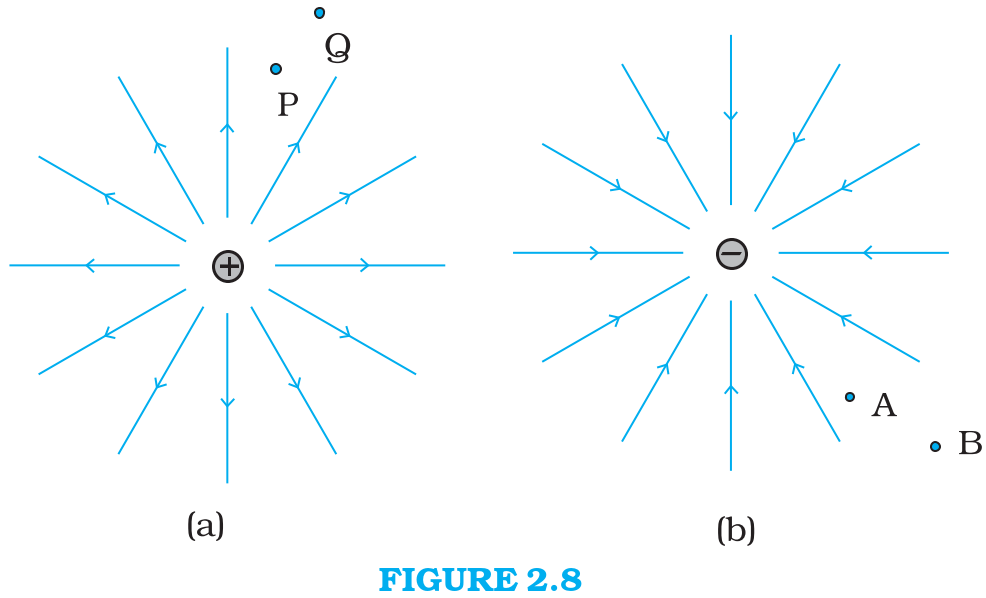
Figures 2.8 (a) and (b) show the field lines of a positive and negative point charge respectively.
Image
(a) Give the signs of the potential difference $V_{ P }-V_{ Q } ; V_{ B }-V_{ A }$.
(b) Give the sign of the potential energy difference of a small negative charge between the points $O$ and $P ; A$ and $B$.
(c) Give the sign of the work done by the field in moving a small positive charge from $Q$ to $P$.
(d) Give the sign of the work done by the external agency in moving a small negative charge from $B$ to $A$.
(e) Does the kinetic energy of a small negative charge increase or decrease in going from $B$ to $A$ ?
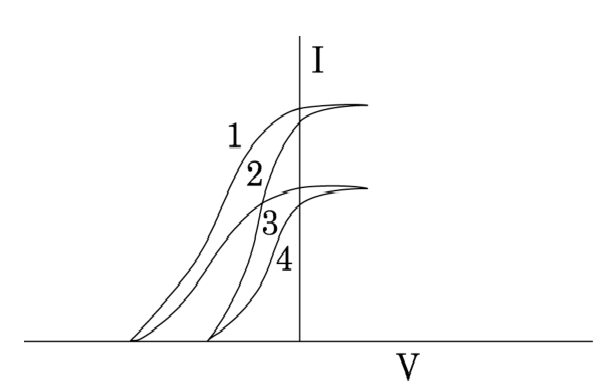
The given graph shows the variation of photo-electric currently) with the applied voltage(V) for two different materials and for two different intensities of the incident radiations. Identify and explain using Einstein's photo electric equation the pair of curves that correspond to (i) different materials but same intensity of incident radiation (ii) different intensities but same materials.

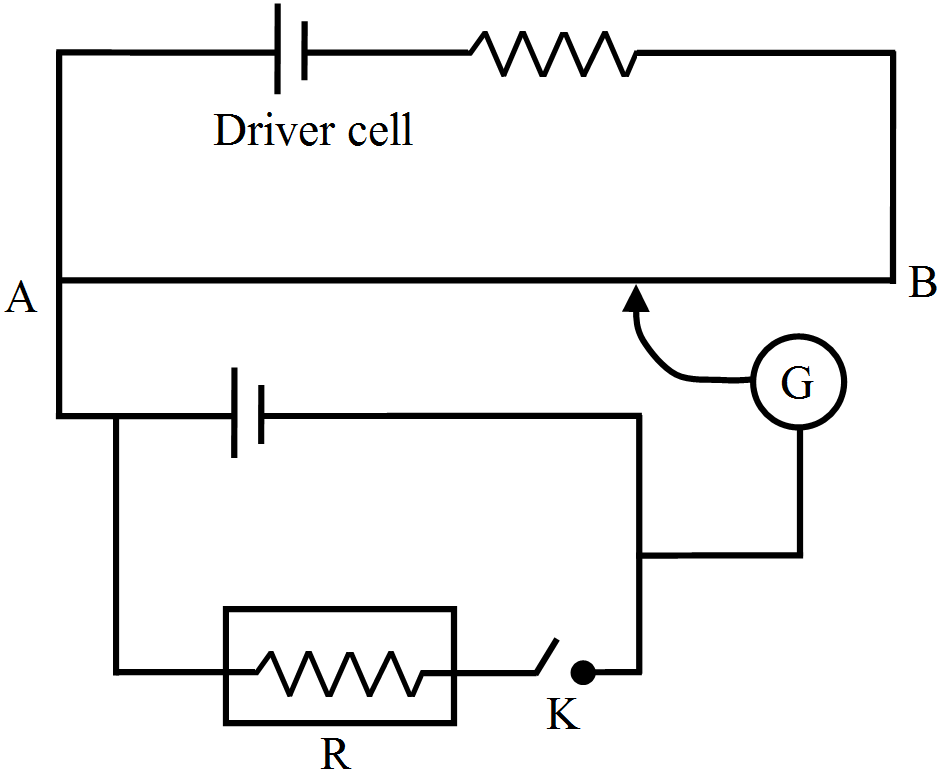
The following circuit shows the use of potentiometer to measure the internal resistance of a cell:

  1. When the key is open, how does the balance point change, if the current from the driver cell decreases?
  2. When the key K is closed, how does the balance point change if R is increased keeping current from the driver cell constant?
A metre stick is held vertically with one end on a rough horizontal floor. It is gently allowed to fall on the floor. Assuming that the end at the floor does not slip, find the angular speed of the rod when it hits the floor.
Calculate the ratio of the angular momentum of the earth about its axis due to its spinning motion to that about the sun due to its orbital motion. Radius of the earth = 6400km and radius of the orbit of the earth about the sun = 1.5 × 10⁸km.
The geostationary orbit of the earth is at a distance of about 36000km from the earth's surface. Find the weight of a 120kg equipment placed in a geostationary satellite. The radius of the earth is 6400km.
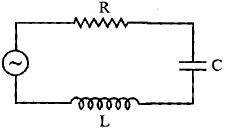
The figure shows a series LCR circuit with L = 5.0 H, C = 80 $\mu$F, R = 40 W connected to a variable frequency 240V source. Calculate

  1. The angular frequency of the source which drives the circuit at resonance.
  2. The current at the resonating frequency.
  3. The rms potential drop across the capacitor at resonance.
Assume that each atom in a copper wire contributes one free electron. Estimate the number of free electrons in a copper wire having a mass of 6.4g (take the atomic weight of copper to be 64g mol-1.