Question
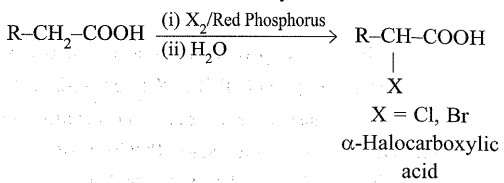
Explain Hell-Volhard-Zelinsky reaction of carboxylic acids.
Answer

→ Carboxylic acids having an $\alpha$-hydrogen are halogenated at the $\alpha$-position on treatment with chlorine or bromine in the presence of small amount of red phosphorus to give $\alpha$-halocarboxylic acids. The reaction is known as Hell-Volhard-Zelinsky reaction.
Image

Need a full question paper?

Generate a complete, print-ready paper with questions like this in minutes — across 16+ boards, with answer keys.

Start Generating Free

Similar questions

Nitric oxide, NO, reacts with oxygen to produce nitrogen dioxide.
$\text{2NO(g)+O}_2(\text{g)}\rightarrow\text{2NO}_2\text{(g)}$
The rate law for this reaction is:
$\text{Rate = k}[\text{NO]}^2[\text{O]}_2$
Propose a machanism for the reaction.
Explain why limestone is used in the manufacture of cast iron from haematite?
Note: In the following questions a statement of assertion followed by a statement of reason is given. Choose the correct answer out of the following choices.
  1. Both assertion and reason are true and the reason is the correct explanation of assertion.
  2. Both assertion and reason are true and the reason is not the correct explanation of assertion.
  3. Assertion is true but the reason is false.
  4. Both assertion and reason are false.
  5. Assertion is false but reason is true.
Assertion: Electrolysis of NaCl solution gives chlorine at anode instead of O2.
Reason: Formation of oxygen at anode requires overvoltage.
What is the effect of denaturation on the structure of proteins ?
  1. Write structures of different isomeric amines corresponding to the molecular formula, C4H11N.
  2. Write IUPAC names of all the isomers.
  3. What type of isomerism is exhibited by different pairs of amines?
Calculate the volume of water which could be added to 20 ml of 0.65 m HCl to dilute the solution to 0.2 m?
Discuss the classification of monohydric alcohols containing Csp2-OH bond.
Match the common names given in Column I with the IUPAC names given in Column II.
 
Column I
(Common names)
 
Column II
(IUPAC names)
(i)
Cinnamaldehyde
(a)
Pentanal
(ii)
Acetophenone
(b)
Prop-2-enal
(iii)
Valeraldehyde
(c)
4-Methylpent-3-en-2-one
(iv)
Acrolein
(d)
3-Phenylprop-2-enal
(v)
Mesityl oxide
(e)
1-Phenylethanone
For which type of reactions, order and molecularity have the same value?
Define an ideal solution and write one of its characteristics.