Question
Explain Hertz's observations for the photoelectric effect.
###
Explain how the photoelectric effect was discovered by Hertz.

Answer

In an experiment to produce electromagnetic waves in a laboratory, when negatively charged particles (electrons) are emitted from a metal plate and passed through a spark gap, a spark is generated in front of a detector loop and electromagnetic waves are emitted.
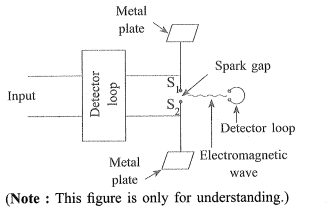
Image
Hertz observed that when rays of ultraviolet light were irradiated on a metal surface with an arc lamp, the spark before the detector loop increased. That is the number of electrons passing through the spark gap also increases.
When ultraviolet light is incident on a metal plate the free electrons in the metal must absorb the energy of the radiation and since this energy is sufficient the electrons must escape from the attraction of the positive ions of the metal, which is the photoelectric effect.
Thus, Hertz first observed the photoelectric effect in 1887 during his experiments on the emission of electromagnetic waves.
Need a full question paper?

Generate a complete, print-ready paper with questions like this in minutes — across 16+ boards, with answer keys.

Start Generating Free

Similar questions

By looking at the construction of a compound microscope and a telescope, how will you distinguish which type of optical instrument is which?
If current flowing in a circular coil is doubled and radius is halved, then what would be the change in the produced magnetic field at the center of the coil?
Identify the electromagnetic waves whose wavelengths vary as :
(a) $10^{-12} m<\lambda<10^{-8}m$ (b) $10^{-3} m<\lambda<10^{-1}m$
Write one use of each.
A convex lens (n = 1.5) of focal length fa is immersed.
  1. In water n = 1.33 and.
  2. In carbon disulphide n = 1.6, how does the lens behave in the two cases?
A uniform electric field of $10NC^{-1}$ exists in the vertically downward direction. Find the increase in the electric potential as one goes up through a height of $50\ cm.$
A steel rod is clamped at its two ends and rests on a fixed horizontal base. The rod is unstrained at $20^\circ C.$ Find the longitudinal strain developed in the rod if the temperature rises to $50^\circ C.$ Coefficient of linear expansion of steel $=1.2 \times 10^{-5}{ }^{\circ} \mathrm{C}^{-1}.$
A cylindrical metal tube has a length of $50\ cm$ and is open at both ends. Find the frequencies between $1000\ Hz$ and $2000\ Hz$ at which the air column in the tube can resonate. Speed of sound in air is $340\ m/s.$
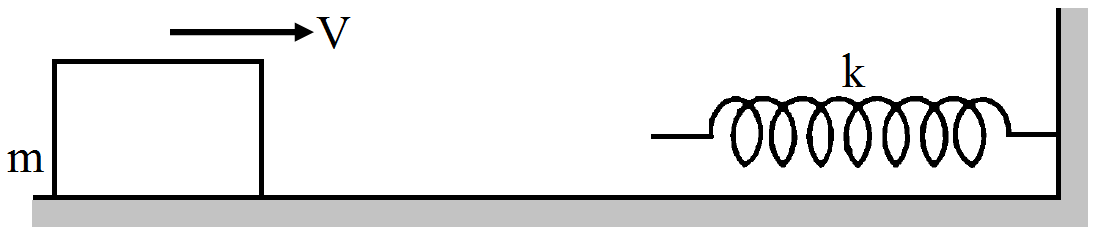
A block of massip, sliding on a smooth horizontal surface with a velocity $\vec{\text{v}}$ meets a long horizontal spring fixed at one end and having spring constant k as shown in figure. Find the maximum compression of tin spring. Will the velocity of the block be the same $\vec{\text{v}}$ when it comes back to the original position shown?
A galvanometer has a resistance of 30Ω. It gives full scale deflection with a current of 2 mA. Calculate the value of the resistance needed to convert it into an ammeter of range 0-0.3 A.
Define trans conductance of a transistor.